

Why Parent Child Swim Classes Give Your Baby the Best Start in Water
Parent child swim classes are structured, in-water sessions where a parent or guardian gets in the pool alongside their infant or toddler — typically from around 6 months up to age 3.
Here’s what you need to know at a glance:
| Question | Quick Answer |
|---|---|
| Who are they for? | Babies and toddlers ages 6 months to 3 years |
| Do parents get in the water? | Yes — adult participation is required |
| How long are classes? | Usually 30 minutes |
| What’s the goal? | Water comfort, basic safety skills, and bonding — not independent swimming |
| When should you start? | The American Academy of Pediatrics recommends swim lessons can begin for many children starting at age 1, though some programs accept babies as young as 4–6 months |
| Why does it matter? | Drowning is a top cause of death among young children — and 69% of drowning incidents involving kids under 5 happen when they were not expected to be in the water |
These classes are not about turning your baby into a competitive swimmer. They’re about building a foundation — water comfort, trust, and early safety awareness — while you and your child learn together.
For busy Bay Area families, getting your little one into the water early isn’t just a fun activity. It’s one of the most meaningful safety steps you can take. Research shows that swim lessons can help reduce drowning risk for children between ages 1 and 4. And beyond safety, there’s something powerful about the shared experience — the splashing, the songs, the giggles — that builds a bond you don’t get on dry land.
Whether your child loves the water instantly or needs a few sessions to warm up, parent child swim classes are designed to meet them exactly where they are.
What to Expect in Parent Child Swim Classes

If you are picturing an instructor barking orders while your six-month-old tries to master the butterfly stroke, you can breathe a sigh of relief. Parent child swim classes are vastly different from traditional, independent swim lessons.
In a standard swim lesson, the goal is often independent propulsion, technical stroke development, and solo survival skills. In a parent-child class, the primary focus is water acclimation, sensory exploration, and safety education. Your baby will not be swimming laps. Instead, they will be experiencing the unique physical sensations of water while cradled securely in your arms.
We use play-based learning to teach fundamental skills. This means we translate essential water-readiness concepts into games, songs, and gentle routines. To a baby, splashing a colorful toy or bobbing up and down to a familiar nursery rhyme is pure fun. To our instructors, these activities are building blocks. They teach breath control, spatial awareness, and muscle memory.
Repetition is the secret ingredient here. Repeating the same songs and routines every week helps infants and toddlers anticipate movements. This predictability builds a deep sense of trust and security in the water. Over time, these playful repetitions turn into instinctive safety habits.
To explore how these early experiences lay the groundwork for a lifetime of water enjoyment, read our article on why Baby Swim Lessons Are Fun for Baby and Parents.
Age Requirements and Class Structure
Most high-quality programs structure their parent child swim classes around developmental milestones, typically serving children from 6 months up to 3 years old.
At American Swim Academy, we know that a young child’s attention span (and internal thermostat) is limited. That is why our classes are structured into focused, engaging 30-minute sessions. Thirty minutes is the sweet spot: long enough to practice core skills and build water familiarity, but short enough to prevent overstimulation, fatigue, or chilling.
Our parent-child curriculum is divided into two distinct developmental stages:
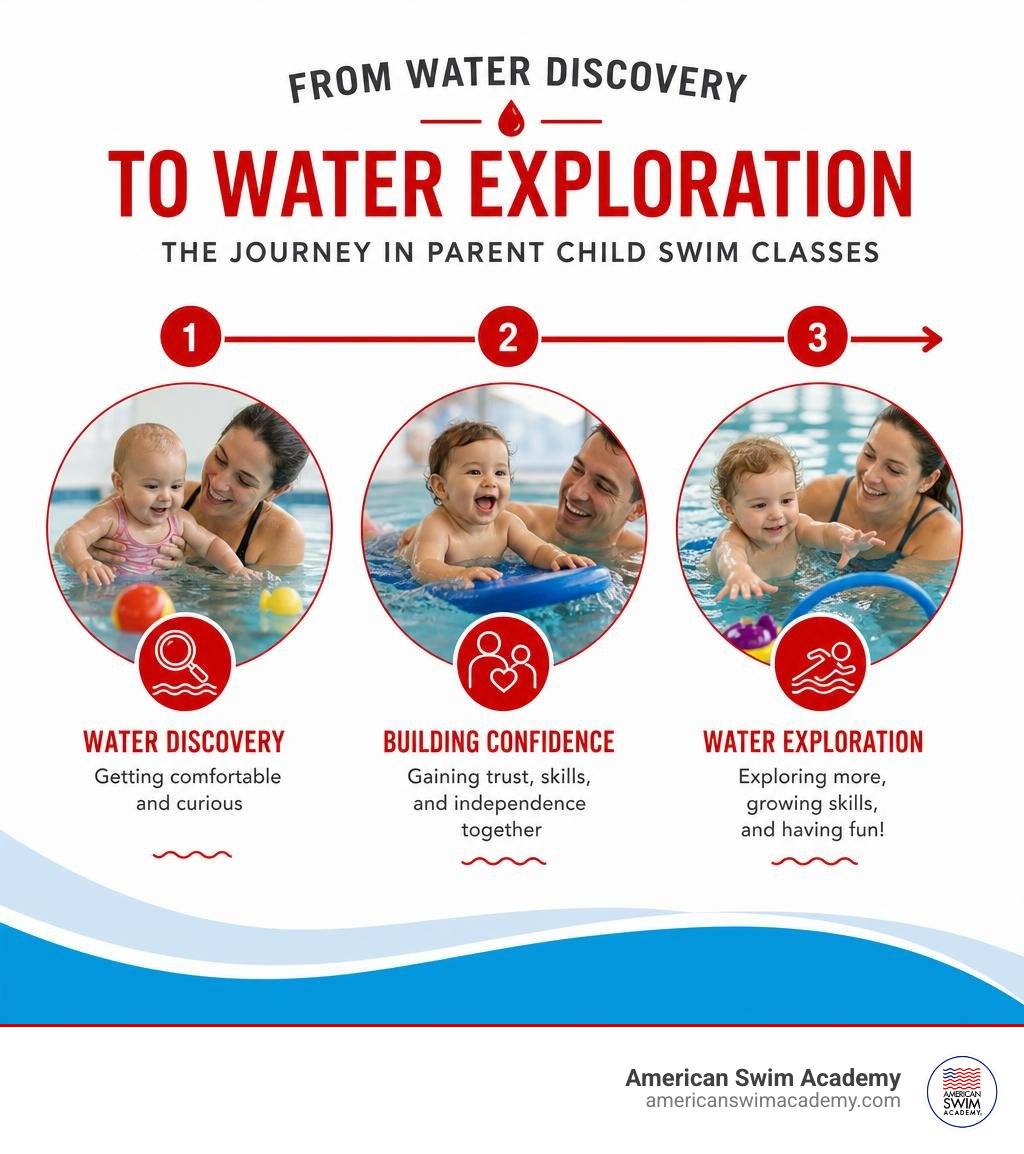
- Stage A (Water Discovery): This stage is designed for our youngest swimmers (typically 6 to 18 months). The focus here is strictly on introducing the infant to the aquatic environment through gentle exploration. Parents learn proper holding techniques, and babies learn to feel comfortable floating on their backs, splashing, and experiencing the sensation of water on their faces.
- Stage B (Water Exploration): Designed for older infants and toddlers (typically 19 to 36 months), this stage builds on initial water comfort. Parents work closely with their children to explore basic body positions, practice blowing bubbles, mimic kicking motions, and practice fundamental safety skills like grabbing the pool wall.
To help you decide which level is the perfect fit for your little one’s current development, check out Water Babies: Your Guide to Finding Mom and Tot Swim Classes.
The Developmental Benefits of Parent Child Swim Classes
The benefits of early water play extend far beyond safety. Splashing around in a warm pool provides a unique sensory and physical workout that supports your baby’s overall development.
First, the water provides gentle, uniform resistance. This resistance helps infants and toddlers build core physical strength, improve balance, and refine their coordination. When your baby kicks, reaches for a floating toy, or balances against the gentle movement of the water, they are engaging major muscle groups in ways they cannot on land.
Second, the emotional benefits are profound. In our busy, screen-filled lives, a swim class offers 30 minutes of uninterrupted, eye-to-eye contact between you and your baby. This dedicated time builds a deep foundation of trust. As your child learns to relax in the water because they feel safe in your arms, that sense of security translates into greater self-confidence outside the pool.
For a deeper look into how these weekly sessions can strengthen your relationship with your child, explore Why Weekly Swim Lessons Are the Ultimate Bonding Experience for Parents and Kids.
Water Safety and Drowning Prevention Strategies

We cannot talk about swimming without talking about safety. Drowning remains a leading cause of accidental death among young children. According to data from the Consumer Product Safety Commission, a staggering 69% of children under the age of 5 who drowned were not expected to be in the water at the time. They slipped away during a lapse in supervision, wandering toward a backyard pool, spa, or natural body of water.
This statistic is a sobering reminder that we must build multiple “layers of protection” around our children. Parent child swim classes serve as a critical layer of protection, but they are not a magic shield. No child is ever “drown-proof.”
Instead, these classes educate both parent and child. While your baby learns basic water adaptation, you learn how to actively supervise, identify potential water hazards, and react in an emergency. To learn more about our commitment to keeping your family secure, review our dedicated Health and Safety protocols.
Touch Supervision and Water Competency
In our parent-child lessons, we emphasize two core safety concepts: “touch supervision” and “water competency.”
Touch supervision means that an adult is always within arm’s reach of the infant or toddler, with eyes on the child at all times, without distractions like phones or books. During pool parties or gatherings, we advocate for designating a dedicated “Water Watcher” whose sole job is to monitor the pool without distraction.
Water competency is the ability to survive an unexpected water entry. In our parent-child classes, we teach foundational skills that form the basis of water competency, including:
- Breath Control: Learning to blow bubbles and hold their breath when water splashes on their face.
- Back Floating: Helping babies learn to relax on their backs, keeping their airway clear to breathe.
- Pool Entry and Exit: Teaching toddlers how to safely slide into the pool and, more importantly, how to turn around, grab the wall, and climb out.
To see how these survival skills are integrated into our progressive curriculum, explore our Water Adaptation program details.
Adaptive Aquatics for Children with Disabilities
We believe that every child, regardless of their physical or cognitive abilities, deserves to feel safe and confident in the water. For children with disabilities, autism, or developmental delays, the sensory benefits of water can be incredibly therapeutic.
The hydrostatic pressure of water provides a soothing, calming environment that can help reduce sensory overload. In our parent-child format, children with special needs can progress at their own pace with the reassuring comfort of their parent’s touch. Our experienced instructors can modify holds, adjust activities, and provide personalized attention to capitalize on your child’s unique strengths.
Whether your child needs a slower pace or specific physical adaptations, our Beginners programs are designed to accommodate and welcome every young swimmer.
Preparing for Your First Swim Lesson
Your first day at the pool should be filled with excitement, not stress! The key to a successful start is keeping the environment low-pressure. Babies are incredibly perceptive; if you are rushing and anxious, they will pick up on that energy. Give yourself plenty of time to pack, arrive early, and acclimate to the sights and sounds of the swim center before it is time to get in.
We recommend introducing your baby to water play at home first. During bath time, gently trickle water over their shoulders and head, practice blowing bubbles together, and encourage splashing. This warm-water play helps normalize the sensory experience of the pool.
When you transition to a formal swim facility, your child will already associate water with comfort and fun. Ready to make the leap? Head over to our Get Started page to take the first step.
How to Choose the Best Parent Child Swim Classes
Not all swim programs are created equal. When researching parent child swim classes in the East Bay, keep these essential criteria in mind:
- Water Temperature: This is a non-negotiable for infants and toddlers under 3. Young children cannot regulate their body temperature as efficiently as adults. Look for facilities with heated indoor pools maintained between 90°F and 94°F. At American Swim Academy, our pools are heated to a comfortable 92°F year-round to ensure your baby stays warm, relaxed, and happy.
- Instructor Qualifications: Ensure instructors are specifically trained in infant development, water safety, and positive reinforcement techniques.
- Class Ratios: Small group sizes are critical. A lower student-to-instructor ratio ensures the instructor can observe every pair and provide personalized feedback.
- Facility Cleanliness: Look for advanced water purification systems, such as UV-C light sanitation combined with traditional chlorine, to ensure pristine water quality.
We invite you to visit our convenient Bay Area Locations in Fremont, Newark, Livermore, Dublin, and Walnut Creek to see our warm, family-friendly facilities firsthand.
Essential Gear and Swim Diaper Policies
To keep our pools clean, safe, and open for everyone, we enforce a strict swim diaper policy. Standard disposable diapers are designed to absorb liquid, meaning they will instantly balloon up like a heavy anchor the moment they touch the water.
For children under the age of 3, or those who are not fully potty trained, we require a double-diaper system:
- Under-layer: A disposable swim diaper, like Huggies Little Swimmers, or a reusable swim diaper.
- Over-layer: A snug-fitting, reusable neoprene swim pant or diaper cover. This second layer acts as a secure seal to prevent any accidental leaks.
Along with your double-diaper setup, be sure to pack:
- Snug-fitting swimsuits for both baby and parent.
- Two warm, fluffy towels, one for baby and one for you.
- A change of dry, warm clothes for after the lesson.
- A plastic bag to store wet gear.
- A small snack or bottle for after class, because swimming makes babies hungry!
For more packing tips and seasonal advice, keep an eye on our Blog.
Frequently Asked Questions about Infant Swim Lessons
What age can my baby start swimming lessons?
We welcome babies into our parent-child program starting at 6 months old. At this stage, infants have developed the neck strength and head control needed to safely participate in structured water activities. However, developmental readiness varies from child to child. We always recommend consulting with your pediatrician before starting any new physical program.
Once your child turns 3 and is ready to transition to independent classes, they can seamlessly move into our Pre School curriculum.
What should my baby wear to swim lessons?
Your baby should wear a comfortable, snug-fitting swimsuit over a approved double-diaper system (a disposable or reusable swim diaper underneath, covered by a snug neoprene outer swim diaper). Avoid loose, baggy rash guards or heavy wetsuits, as they can restrict movement and make it harder for you to maintain a secure grip on your baby in the water.
How long and how frequent are the classes?
Our parent-child lessons run for 30 minutes, which is the developmentally appropriate limit for infants and toddlers. We recommend attending class once a week. Weekly consistency is key to building a comfortable routine, reinforcing muscle memory, and helping your child build a lifelong, positive relationship with the water.
Conclusion
Enrolling in parent child swim classes is one of the most rewarding decisions you can make for your child’s physical development, safety, and emotional well-being. These classes aren’t about pressure or performance; they are about joy, connection, and peace of mind.
At American Swim Academy, we make your child’s first water experiences warm and welcoming. With our 92° heated indoor pools, small class sizes, and caring, highly experienced instructors, we provide the perfect environment for your family’s swim journey.
We are proud to serve Bay Area families across our convenient locations in Fremont, Newark, Livermore, Dublin, and Walnut Creek. Ready to take the first splash together? Explore Our Programs today, and let’s build a foundation of water safety and fun that will last a lifetime.