

Why Finding the Right Swim Classes Matters for Your Family
Swim classes are one of the most valuable investments you can make for your child — and yourself.
Here’s a quick overview of what’s available:
| Who It’s For | Class Type | Typical Age Range |
|---|---|---|
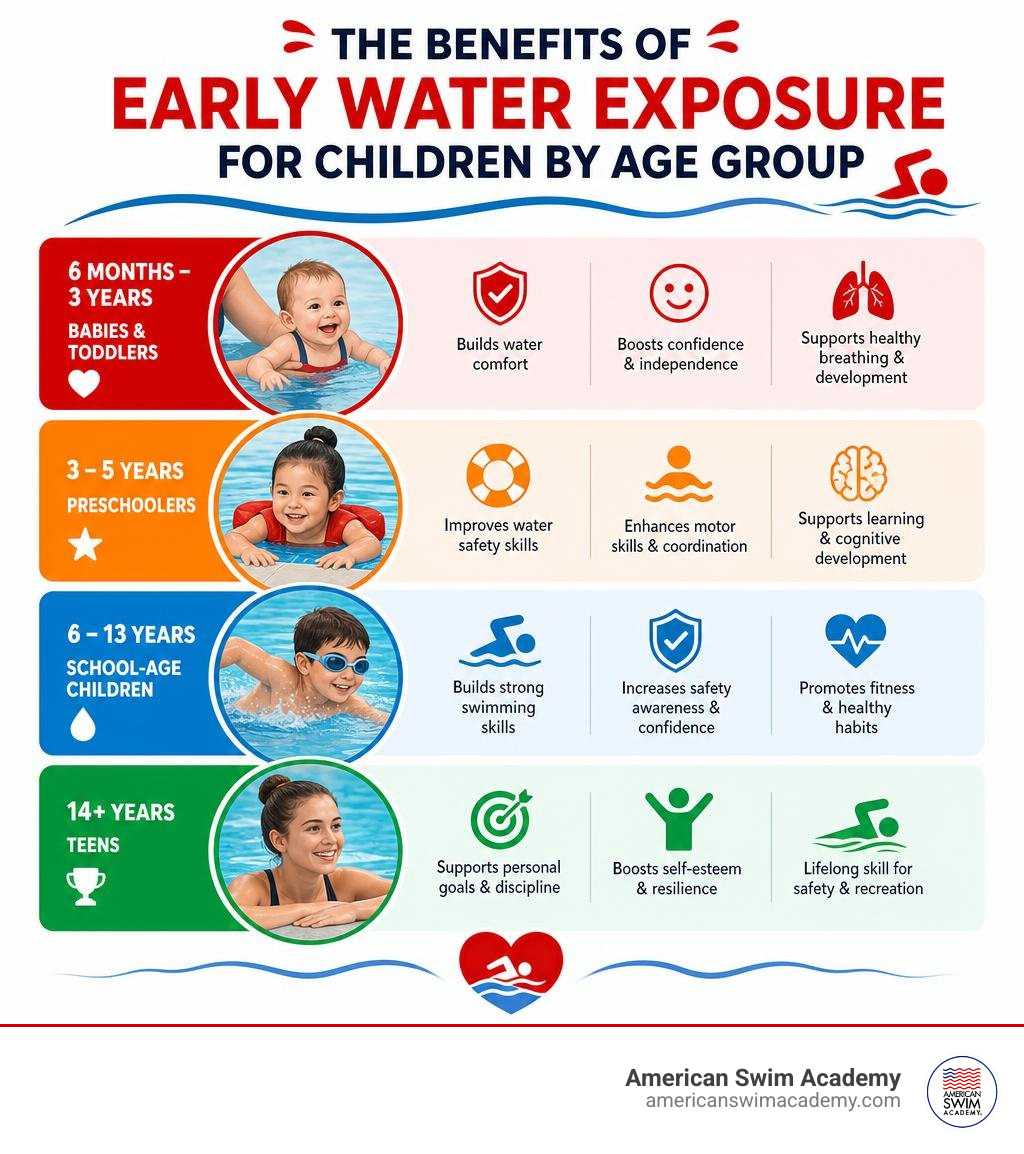
| Babies with a parent | Parent & Child | 6 months – 3 years |
| Independent beginners | Preschool classes | 3 – 5 years |
| Building stroke skills | Youth/School-Age | 6 – 13 years |
| Fitness and confidence | Teen & Adult | 14+ years |
| Focused skill work | Private or Semi-Private | Ages 3+ |
Whether you’re looking for a weekend class for your toddler or a beginner program for yourself, there are structured options for every age and skill level — from basic water comfort all the way to stroke refinement.
Learning to swim builds confidence, supports physical fitness, and teaches skills that last a lifetime. And the earlier children start, the more natural the water feels to them. Research from programs across the country consistently shows that structured, age-appropriate instruction — paired with warm water, small class sizes, and certified instructors — leads to the fastest progress.
At American Swim Academy, year-round indoor heated pools mean your family never has to wait for summer to get started.
Glossary for swim classes:
Choosing the Right Swim Classes for Every Age Group
Selecting the perfect class depends heavily on finding an environment that matches a swimmer’s developmental stage. When instruction aligns with physical and emotional milestones, learning to swim becomes a joyful experience rather than a stressful chore.
In our years of teaching across the Bay Area, we have found that separating classes by narrow age brackets ensures that every student receives instruction tailored to their attention span, motor skills, and social comfort.
Parent and Child Water Adaptation
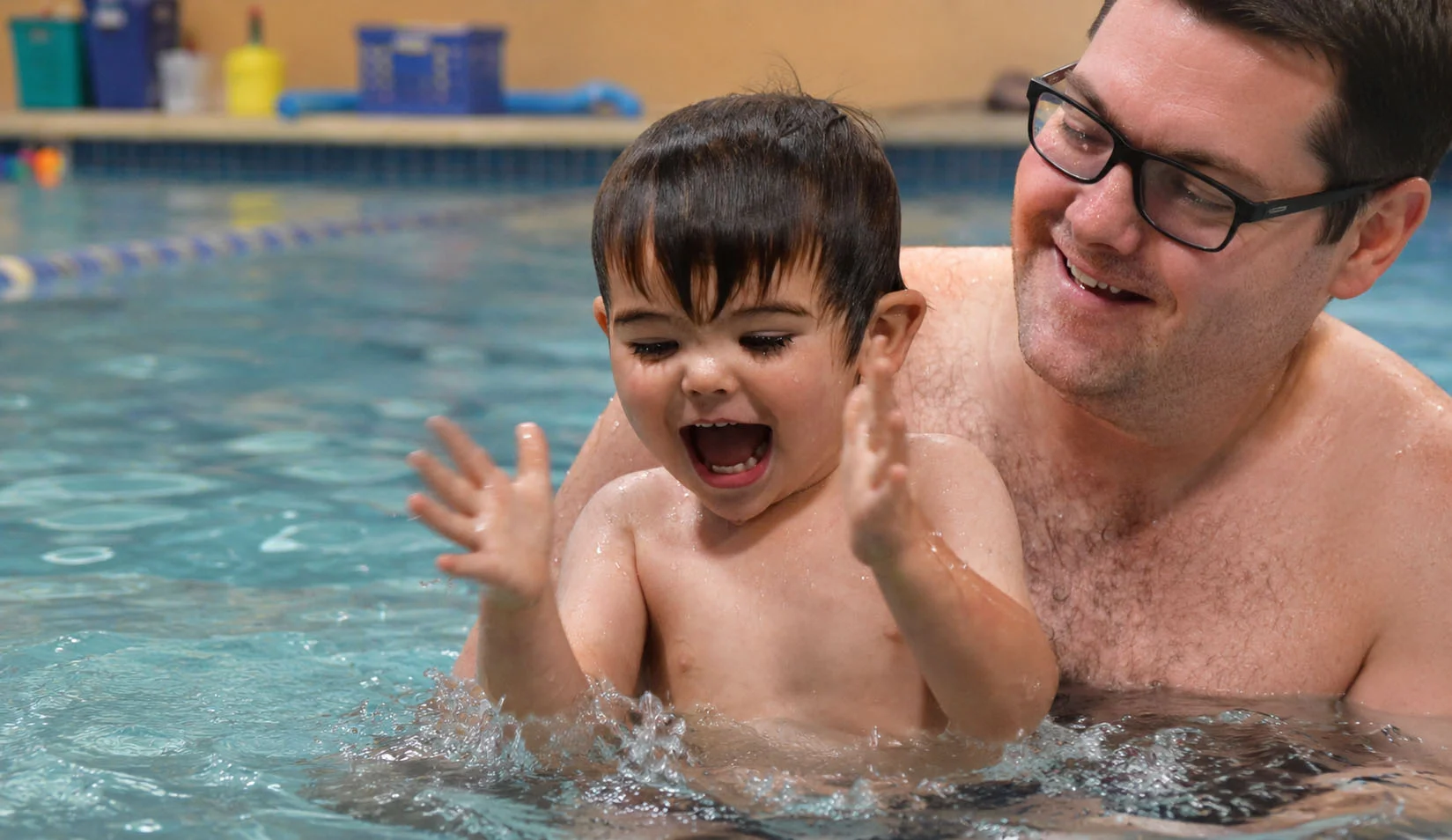
For our youngest learners, the water is a brand-new world of sensory experiences. Our parent-assisted classes are designed for infants and toddlers, typically starting around 6 months of age. At this stage, the primary goal is not mastering complex strokes but building a foundation of comfort and trust.
In these sessions, parents join their little ones in the pool, guided by our experienced instructors. We focus on gentle water acclimation, bubble blowing, back floats, and basic kicking. Parents also learn crucial safety techniques, including proper support holds and how to safely supervise their children around water.
Our specialized Water Adaptation program emphasizes bonding and play, helping babies view the pool as a safe, happy place. By starting early, infants naturally develop the muscle memory and coordination that make future independent swimming much easier to master.
Preschool Swim Classes
Around age 3, children reach a developmental transition. They are growing more independent, can follow simple directions, and are ready to learn without a parent by their side. This is where our Pre School classes step in.
In these small group settings, we focus on independent movement, basic safety habits, and building water confidence. Preschoolers learn to submerge their faces comfortably, float on their fronts and backs, and perform basic paddle strokes. Because young children can easily become overwhelmed or distracted, we maintain exceptionally small class ratios. This ensures that every child receives the direct attention and physical support they need to feel secure as they take their first solo splashes.
In the Bay Area, parents looking for preschool options might consider seasonal community programs. However, for consistent, year-round progress in a warm indoor environment, our dedicated academy programs run continuously.
School-Age and Youth Progression
For children aged 6 and older, instruction transitions into a more structured curriculum. School-age swimmers have the physical strength and coordination required to master complex stroke mechanics and build endurance.
Our youth Beginners program is designed to guide students systematically from basic water comfort to advanced stroke execution. We teach safety habits alongside core techniques, such as proper body positioning, side breathing, and rhythmic kicking. As students progress, they learn the fundamentals of freestyle, backstroke, and breaststroke.
Regular practice helps school-age children build cardiovascular fitness, improve coordination, and develop a strong sense of personal achievement as they graduate from one skill level to the next.
Teen and Adult Swim Classes
It is a common misconception that swim lessons are only for young children. In reality, many teens and adults want to learn to swim or refine their existing skills. Whether you are looking to build confidence in the water, improve your fitness, or train for an event, we offer dedicated classes tailored to your needs.
Our Adult and Young Adult classes provide a supportive, low-pressure environment. We understand that adult learners process instruction differently than children. We focus on clear explanations of buoyancy physics, breath control, and efficient stroke mechanics.
By grouping teens and adults with peers of similar ages, we eliminate the self-consciousness that often keeps older beginners out of the water, helping everyone build confidence at their own pace.
Understanding Skill Levels and Progression Stages
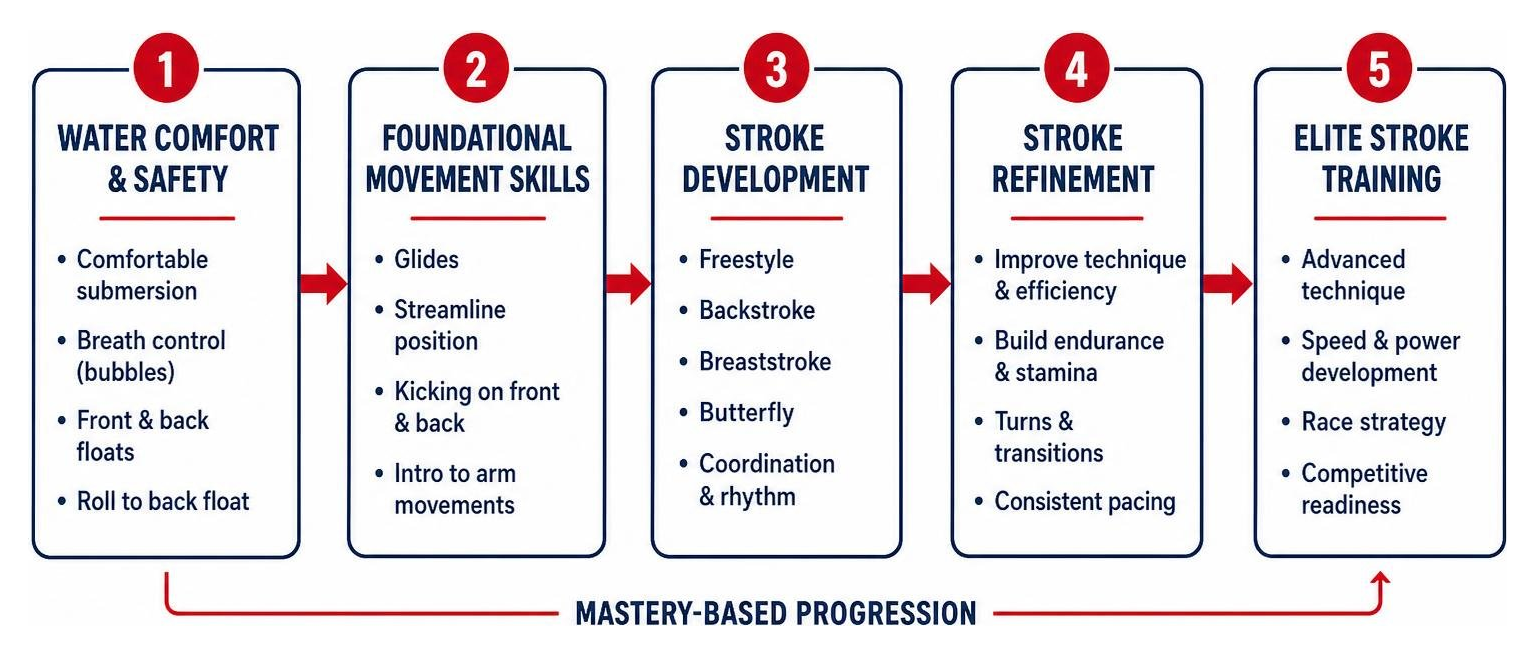
To ensure safety and steady progress, we use a structured, mastery-based advancement system. Instead of automatically promoting students based on their age or the number of weeks they have spent in a class, we advance them only when they have fully mastered specific, measurable skills.
Water Comfort and Basic Safety
Before a student can learn to swim across a pool, they must feel completely at home in the water. The earliest stages of our Swimming programs focus heavily on water comfort and fundamental safety behaviors.
Students learn to comfortably submerge their heads, blow bubbles to control their breathing, and open their eyes underwater. Floating is the absolute cornerstone of water safety. We teach independent front and back floats, as well as the ability to roll from a front position to a back float to rest and breathe. These foundational skills ensure that if a swimmer ever tires, they know exactly how to relax and remain buoyant.
Stroke Development and Refinement
Once a student is completely comfortable in the water and can float independently, we transition into stroke development. This stage focuses on efficiency, coordination, and building physical stamina.
Students begin with the front crawl (freestyle) and back crawl (backstroke), learning how to coordinate their arm movements with continuous kicking and proper side breathing. From there, we introduce breaststroke and butterfly, which require a high degree of rhythm and core strength.
For advanced swimmers, our Stroke Training Elite Swimmers and Intermediate Advanced programs focus on fine-tuning mechanics, improving speed, and mastering turns to prepare students for competitive environments.
Group vs. Private Swim Lessons: Which is Best?
When enrolling in swim classes, one of the most important decisions you will make is choosing between group and private formats. Both options offer unique advantages, and the right choice depends on your child’s personality, learning style, and specific goals.
| Feature | Small Group Classes | Private Lessons |
|---|---|---|
| Student-to-Teacher Ratio | Typically 1:3 to 1:4 | 1:1 |
| Social Environment | High peer interaction & motivation | Focused solely on the individual |
| Pacing | Structured curriculum with peers | Fully customized to the student’s speed |
| Cost | More budget-friendly | Higher investment per session |
| Best For | Social learners, building general skills | Hesitant beginners, rapid skill refinement |
The Benefits of Small Group Classes
For the vast majority of children, small group classes are highly effective and engaging. Children are naturally social creatures, and learning alongside peers provides an incredible boost of motivation. Watching a classmate successfully float or blow bubbles often gives hesitant swimmers the confidence to try it themselves.
In our group programs, which you can explore on Our Programs page, we keep class sizes exceptionally small. This allows us to maintain a structured, fun curriculum while still providing plenty of individual feedback. Group classes are also highly cost-effective, making them an excellent choice for families seeking consistent, long-term instruction.
Personalized Attention in Private Lessons
While group classes are wonderful, some students thrive with one-on-one attention. Private lessons are highly recommended for individuals who are hesitant in the water, swimmers with specific learning needs, or those looking to refine a particular stroke technique quickly.
In a private lesson, the instructor’s attention is focused entirely on one student for the duration of the class. This allows for immediate corrections, a highly customized pacing plan, and flexible goal setting. Families in our immediate service areas can easily book personalized instruction directly at our dedicated facilities to achieve rapid progress.
Key Factors to Consider When Enrolling in Aquatics Programs
Not all swim schools are created equal. To ensure your family has a safe, comfortable, and successful experience, it is important to evaluate several critical aspects of any aquatics program before signing up.
Pool Temperature and Facility Comfort
One of the most overlooked factors in swim instruction is pool temperature. If a child is shivering, their muscles tense up, their focus disappears, and they quickly begin to associate the pool with physical discomfort. This is especially true for infants and toddlers, who cannot regulate their body temperature as efficiently as adults.
At American Swim Academy, we solve this problem by keeping our indoor pools heated to a warm, inviting 92° year-round. This comfortable temperature relaxes muscles, reduces anxiety, and allows students to focus entirely on their instructors. Year-round indoor facilities also ensure that your child’s learning is never interrupted by winter weather, seasonal closures, or poor air quality.
For families exploring seasonal municipal options, community pools may offer summer programs. However, for consistent, year-round progress in a warm, temperature-controlled environment, indoor academies remain the gold standard.
Instructor Certifications and Safety Guidelines
Safety should always be the number one priority at any aquatic facility. Professional swim schools must enforce rigorous safety standards to protect participants and staff alike.
When researching programs, always verify that the instructors hold current certifications in CPR, First Aid, and Lifeguarding. Beyond certifications, our instructors undergo extensive internal training to master our gentle, encouraging teaching methodology. We also enforce strict pool-side safety rules, requiring all swimmers to shower before entering the water and encouraging parents to actively watch the lessons from our comfortable viewing areas. General pool hygiene practices also align with public health guidance, such as the CDC Healthy Swimming resources.
Registration Processes and Policies
Understanding how a swim school manages its schedules, registration, and cancellations can save you significant time and frustration. Some municipal programs run on strict seasonal enrollment windows or lottery systems, which can make securing a spot difficult.
At American Swim Academy, we make the process simple and accommodating. We offer continuous, year-round open registration, allowing you to join a class whenever you are ready. You can easily start the process online by visiting American Swim Academy to find a schedule that fits your busy life.
Frequently Asked Questions About Swim Lessons
Navigating swim instruction can bring up plenty of questions. Here are some of the most common inquiries we receive from parents and adult students.
What should my child wear to their first lesson?
Proper swimwear is essential for comfort and hygiene in the pool. All students should wear a well-fitting, non-cotton swimsuit. Cotton fabrics absorb water, become heavy, and can make floating and moving much more difficult.
For children who are not fully potty-trained, a reusable swim diaper is strictly required to maintain water cleanliness. Regular diapers are not allowed, as they swell up and break apart in the pool. Goggles are highly recommended for older children to protect their eyes and help them feel comfortable looking underwater, while swim caps are excellent for keeping long hair out of the face. For more details on preparation, check out our FAQ page.
What is the typical duration and frequency of classes?
Most standard youth and beginner swim lessons are structured as 30-minute sessions. Thirty minutes is the ideal duration for maintaining high energy, focus, and muscle retention, especially for younger children.
To see real, lasting progress, consistency is key. We highly recommend attending classes at least once a week. Regular, year-round practice ensures that students retain their skills and continue to build strength, rather than experiencing the regression that often happens when taking long breaks between seasonal sessions.
What happens if we miss a scheduled class?
We know that family life can be unpredictable, and illnesses or schedule conflicts are bound to happen. When choosing a swim program, always review their makeup and cancellation guidelines.
To support our busy families, we offer flexible makeup class options. If you need to cancel or reschedule a class, simply notify us in advance through our member portal so we can open up the spot for another swimmer and help you book a convenient makeup session.
Conclusion
Learning to swim is a life-changing journey that opens the door to a lifetime of health, fun, and water confidence. Whether you are introducing your baby to their very first splashes, helping your school-age child master their strokes, or taking the plunge as an adult beginner, finding the right class is the key to success.
At American Swim Academy, we are dedicated to providing the highest quality instruction in a warm, welcoming environment. With our small class sizes, caring instructors, and warm 92° indoor pools, we make learning to swim a positive experience for the entire family.
We invite you to explore our convenient Bay Area locations in Fremont, Newark, Livermore, Dublin, and Walnut Creek. Ready to take the first step? Visit Our Programs page today to find the perfect class and begin your swim journey!