

Why Free Swimming Classes for Special Needs Are Hard to Find — And Where to Start
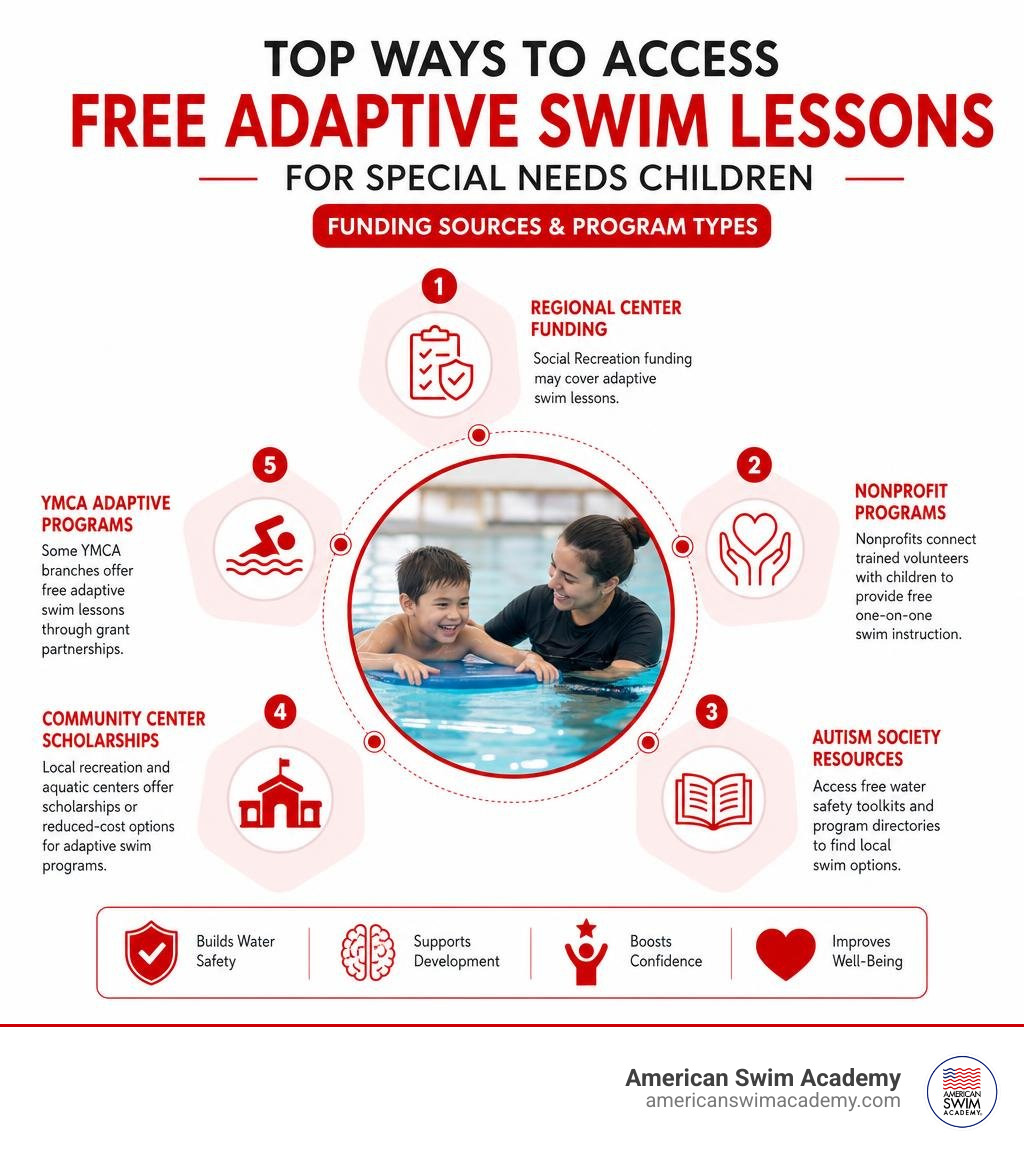
If you’re a parent looking for free swimming classes for special needs near me, here are the most common places to start your search:
- Regional Center funding — Families connected to Inland Regional Center or similar agencies may qualify for Social Recreation funding that covers adaptive swim lessons
- Nonprofit programs — Various volunteer-led organizations connect university student volunteers with special needs children in low-income communities to deliver free one-on-one swim instruction
- Community center scholarships — Many city recreation departments and aquatic centers offer reduced-cost or scholarships for adaptive swim programs
- Autism Society resources — The Autism Society Inland Empire offers a free Swimming and Water Safety Toolkit (in English and Spanish) and a local program directory
- Community adaptive programs — Some local community centers and organizations offer free group or private adaptive swim lessons through grant partnerships
Finding the right swim program for a child with autism, ADHD, Down syndrome, or another disability is not always straightforward. Most parents already know that swimming is important. But the combination of cost, limited spots, and lack of trained instructors can make it feel out of reach.
Water safety is a critical life skill for children with autism, ADHD, Down syndrome, or other developmental needs, helping them build confidence and security around water. And yet, swimming is also one of the most therapeutic activities available — shown to support speech development, cognitive processing, sensory integration, and self-esteem.
That gap between safety and access is exactly why programs built around adaptive swim instruction matter so much.
This guide walks Bay Area and Inland Empire families through their real options — from free programs and funding sources to what to look for in a qualified adaptive swim instructor.
Free swimming classes for special needs near me basics:
The Importance of Free Swimming Classes for Special Needs Near Me
When parents search for free swimming classes for special needs near me, they are usually looking for a program that offers more than just basic stroke instruction. They are searching for a safe space where their child’s unique sensory, physical, and developmental needs are met with patience and specialized expertise.
Water safety is a critical life skill, but the therapeutic benefits of the water extend far beyond safety. For children with special needs, the physical properties of water provide a uniquely supportive environment. The buoyancy of water relieves pressure on joints and muscles, which is incredibly liberating for children with physical disabilities or mobility challenges.
At the same time, the hydrostatic pressure of water acts like a gentle, continuous hug, which can quiet the nervous system and help children with autism or sensory processing disorders feel grounded and calm. This calming effect makes it much easier for them to focus on cognitive processing and motor skills development.
Through customized instruction, children can learn essential water safety skills while simultaneously improving their physical strength, coordination, and self-esteem. We believe that every child deserves to feel comfortable and confident in the water. That is why we focus heavily on our specialized Water Adaptation services, designed specifically to help hesitant or neurodivergent swimmers build a positive relationship with the water at their own pace.
For families seeking local resources across the Bay Area, finding the right program close to home is essential. Whether you are looking for adaptive swim lessons in Fremont, Newark, Walnut Creek, or other parts of the East Bay, there are specialized programs designed to support your child’s unique journey. Finding a local program that understands these unique needs ensures your child can learn in a supportive, stress-free environment.
Types of Adaptive Swim Programs and Accommodations
Not all swim lessons are created equal, especially when it comes to accommodating different abilities. Depending on your child’s personality, sensory preferences, and physical support needs, certain class formats may be a better fit than others.
| Program Type | Best Suited For | Key Accommodations |
|---|---|---|
| Private 1:1 Lessons | Children with high sensory needs, physical disabilities, or those who need a highly customized pace. | Individualized attention, minimal distractions, customized visual schedules, and physical assistance. |
| Small Group Adaptive | Swimmers who benefit from peer modeling and social interaction but still need a high instructor-to-student ratio. | Small class sizes, peer encouragement, structured routines, and social stories. |
| Adaptive Recreation Teams | Confident swimmers ready to build endurance, learn competitive strokes, and participate in a team environment. | Modified stroke techniques, visual swim lanes, and supportive team dynamics. |
Private 1:1 Lessons for Individualized Attention
For many neurodivergent children, a traditional group class can feel overwhelming. The echo of a busy pool, splashing water, and multiple instructions being shouted at once can lead to sensory overload. Private one-on-one lessons allow the instructor to focus entirely on the child’s comfort level, using gentle techniques to build trust. This format is ideal for tailoring instruction to unique learning styles, allowing the instructor to use specific motivators and adapt the lesson plan in real-time.
Small Group Classes and Adaptive Recreation
If your child is ready for a social setting, small group adaptive classes offer a wonderful balance of peer interaction and personal support. These classes typically maintain a very low student-to-instructor ratio to ensure safety and focused attention. In the East Bay, local adaptive recreation sessions and municipal offerings provide structured, inclusive environments where children can play, learn, and grow alongside their peers.
Visual Supports and Social Stories
To help special needs swimmers succeed, quality adaptive programs incorporate specialized teaching tools. Visual supports—such as waterproof picture cards illustrating “kick,” “blow bubbles,” or “float”—help children who process information visually. Social stories are also incredibly helpful; these are short, personalized stories with pictures that walk a child through exactly what to expect during their swim lesson, reducing anxiety before they even dip their toes in the water.
Funding, Scholarships, and Regional Center Support
While specialized private lessons are highly effective, the cost can add up quickly. Fortunately, there are several ways for families in California to access financial assistance, grants, and scholarships to make adaptive swim lessons affordable, and in many cases, entirely free.
Regional Center Social Recreation Funding
In California, the Lanterman Act guarantees services and supports for individuals with developmental disabilities. If your child is a client of a local regional center, such as the Regional Center of the East Bay (RCEB) serving Alameda and Contra Costa counties, or the San Andreas Regional Center (SARC), you may be eligible for funding. Families can learn more about California’s regional center system through the California Department of Developmental Services.
In recent years, California restored funding for “Social Recreation” services. This means that regional centers can now fund adaptive swim lessons, therapeutic recreation, and water safety classes if they are written into your child’s Individual Program Plan (IPP). To access this, contact your Regional Center Service Coordinator and request an assessment for adaptive swim funding.
Local Grants and Scholarships
Many community organizations and municipalities offer direct scholarships for families in need. City recreation departments often have “recreation scholarship funds” that can cover a significant portion of adaptive swim program costs. Always ask your local community pool or city park district about financial aid options when registering.
Frequently Asked Questions About Free Swimming Classes for Special Needs Near Me
Who is eligible for free swimming classes for special needs near me?
Eligibility for free or subsidized adaptive swim classes depends on the funding source. For Regional Center funding, your child must be an active client with a qualifying diagnosis such as autism, cerebral palsy, Down syndrome, epilepsy, or a significant developmental delay.
If you are applying through local city scholarships or nonprofit grants, eligibility is typically based on household income or proof of disability. Most programs will ask for basic documentation, which may include:
- A copy of your child’s IEP (Individualized Education Program) or Regional Center IPP.
- A brief medical clearance or recommendation form signed by your child’s pediatrician or physical therapist.
- Proof of residency and household income (for income-based scholarships).
How do I register for free swimming classes for special needs near me?
To get started, we recommend taking the following steps:
- Contact Your Service Coordinator: If you are with a Regional Center, ask about Social Recreation funding options for adaptive aquatics.
- Complete an Intake Form: Most adaptive programs require a detailed intake form where you can share your child’s sensory preferences, physical abilities, communication style, and any specific fears.
- Schedule an Assessment: Many high-quality swim schools will perform a brief, gentle in-water assessment to understand your child’s current comfort level before placing them in a class.
- Plan Ahead: Because adaptive swim spots are highly sought after, try to register several weeks before the season begins.
What qualifications should adaptive swim instructors have?
When searching for the right program, don’t hesitate to ask about the instructors’ training. A great adaptive instructor should possess:
- Specialized Certifications: Training in adaptive aquatics or sensory-focused swim methods.
- Patience and Empathy: An understanding that progress is not always linear, and that building trust is the first and most important step.
- Sensory Strategies: Knowledge of how to modify instructions, use visual aids, and adjust the environment for neurodivergent learners.
- Robust Safety Protocols: Certifications in CPR, First Aid, and Lifeguarding, alongside specific training in water safety for special needs.
Conclusion
Finding the right swim program for your child is a journey, but it is one of the most rewarding investments you can make in their safety, health, and happiness. Whether you access free lessons through Regional Center funding, community scholarships, or local adaptive programs, the goal is to give your child a positive, supportive environment where they can thrive.
At American Swim Academy, we are dedicated to making the water a joyful and safe place for every child. We offer high-quality, year-round indoor swim lessons in our warm, 92-degree heated pools—the perfect temperature to keep sensitive or physical-needs swimmers comfortable and relaxed. With small class sizes and caring, experienced instructors, we meet every swimmer exactly where they are.
We invite you to explore Our Programs to find the perfect fit for your family. With convenient Locations in Fremont, Newark, Livermore, Dublin, and Walnut Creek, CA, expert support is always close to home.
Ready to begin? Contact our friendly team today or visit our Get Started page to take the first step toward building lifelong water confidence!