

Learning to Swim Starts Here: What Every Beginner Should Know
Beginner swim lessons are structured classes that teach first-time swimmers — from babies to adults — how to feel safe, comfortable, and confident in the water.
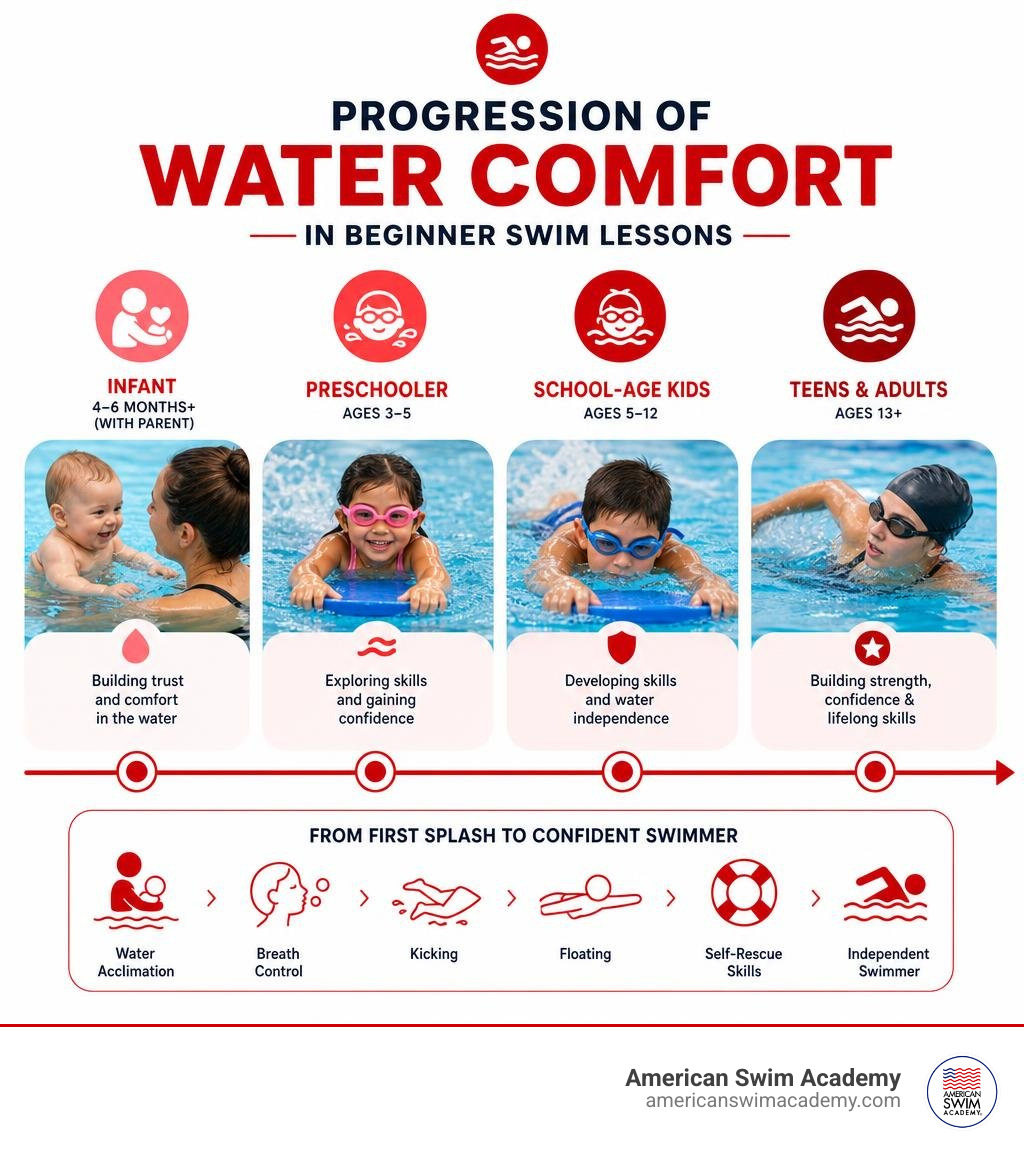
Here’s a quick snapshot of what beginner swim lessons cover:
| Who It’s For | Starting Age | Key Skills Taught |
|---|---|---|
| Infants & toddlers | 4–6 months+ (with parent) | Water comfort, floating, bubble blowing |
| Preschoolers | Ages 3–5 | Face submersion, kicking, basic floating |
| School-age kids | Ages 5–12 | Breath control, front/back float, self-rescue |
| Teens & adults | Ages 13+ | Water entry, floating, basic strokes |
No experience is needed to enroll in a Level 1 beginner class. Most programs start with simple water acclimation — getting comfortable with the water — before building toward floating, kicking, and basic safety skills.
Learning to swim is one of the most valuable skills a child (or adult) can develop. It builds confidence, independence, and a lifelong positive relationship with the water. And the earlier you start, the better — structured programs are available for children as young as 4 to 6 months old.
Whether you’re a Bay Area parent searching for the right class for your toddler, or an adult who never had the chance to learn, this guide walks you through everything you need to know — from what happens in a first lesson to how to pick the right program for your family.
What to Expect in Beginner Swim Lessons
Entering a pool for the first time can bring a mix of excitement and nervous energy. In a high-quality beginner program, the primary focus is not on perfect stroke mechanics right away. Instead, it is about building a trusting relationship with the water and the instructor.
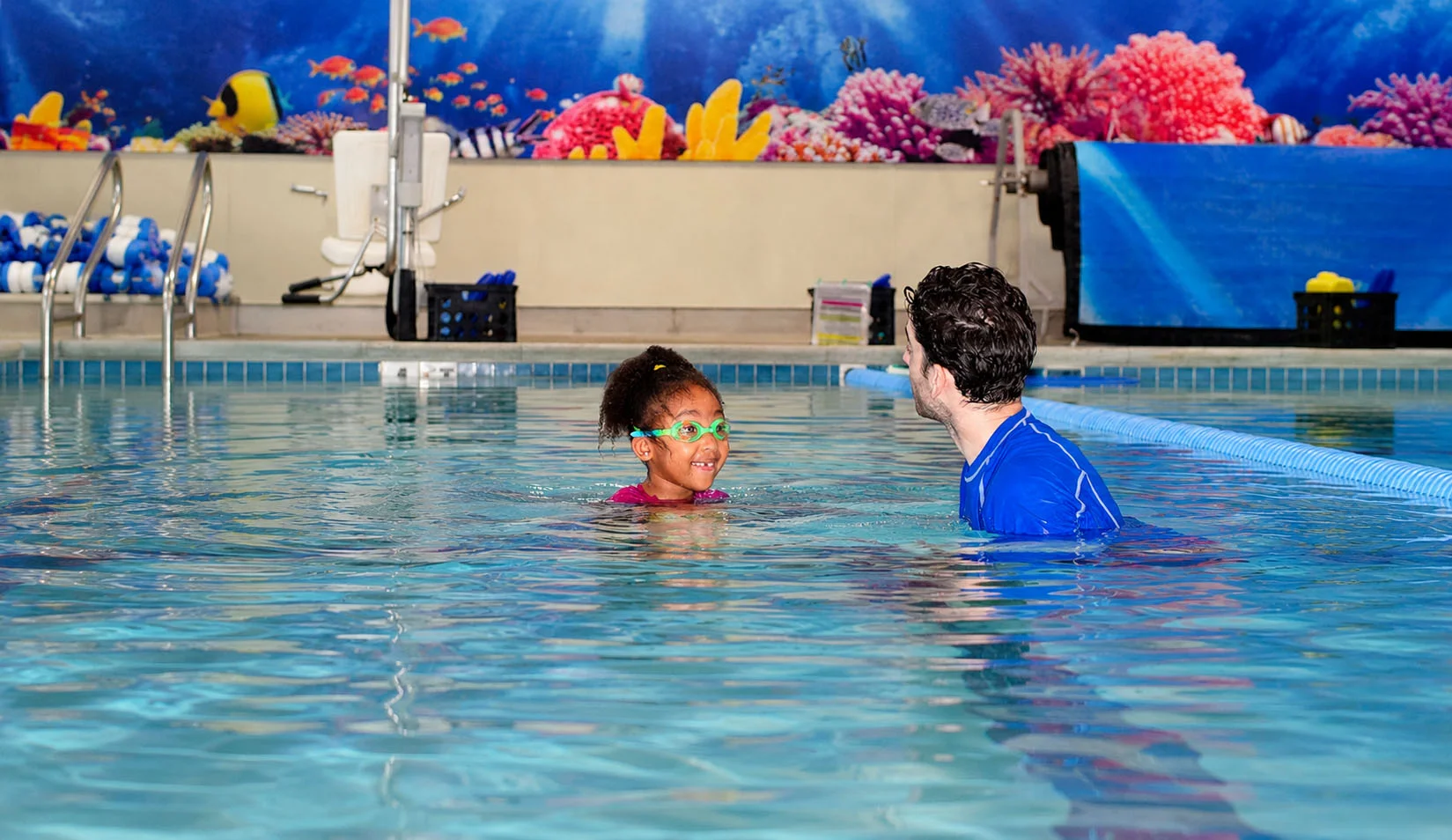
When children or adults first start, they learn that the water is a supportive, fun environment. Instructors use gentle techniques to help students adjust to the sensation of being wet, splashing, and moving their limbs in a buoyant environment. Understanding the fundamentals of Water Safety: The Importance of Swimming Lessons to Kids is woven into every activity, ensuring that students do not just learn to move, but also learn how to respect the water.
In our year-round, warm indoor pools, water acclimation and breath control are introduced slowly and playfully so that no student ever feels rushed or overwhelmed.
Foundational Skills in Beginner Swim Lessons
Every journey to becoming a proficient swimmer relies on mastering a few essential physical benchmarks. During beginner swim lessons, these skills are taught in a logical, step-by-step sequence:
- Blowing Bubbles and Breath Control: Swimmers learn to hold their breath above water and slowly exhale through their mouth and nose at the surface. This prevents water from entering the nose and teaches rhythmic breathing.
- Front Float: Resting on the stomach with the face in the water, supported initially by an instructor or a kickboard, helps students understand their natural buoyancy.
- Back Float: Floating on the back is a crucial milestone. It allows the swimmer to rest and breathe freely. Because it can feel disorienting at first, instructors support the back of the student’s head and count out loud to reassure them.
- Flutter Kicking: Before introducing complex arm movements, students learn to generate power from their hips with straight, relaxed legs.
These core milestones are the focus of Our Programs – Beginners, where we ensure each child builds a strong physical foundation before moving on to advanced strokes.
Essential Water Safety and Self-Rescue Skills
Beyond the physical mechanics of swimming, beginner lessons must teach students how to handle unexpected situations. We place a massive emphasis on self-rescue techniques from day one. These skills are designed to become second nature, giving children the tools they need to stay safe.
- The Monkey Crawl: This safety skill teaches children to hold onto the edge of the pool deck with both hands and shimmy their way along the wall until they reach a safe exit point, like a set of stairs or a shallow ledge.
- Assisted Jump, Turn, and Grab: Students practice jumping into the water from a seated or standing position, immediately turning around in the water, and grabbing onto the pool edge. This simple sequence is incredibly effective for building muscle memory and confidence near the water’s edge.
We discuss these concepts in depth in our guide on How Swimming Lessons Keep Your Child Safe, highlighting how early safety training builds a secure boundary of protection around young swimmers.

Choosing the Right Program for Different Age Groups
A child’s developmental stage determines how they interact with the water. A toddler learns through play, songs, and sensory exploration, while an older child or adult can process technical directions and abstract safety concepts.
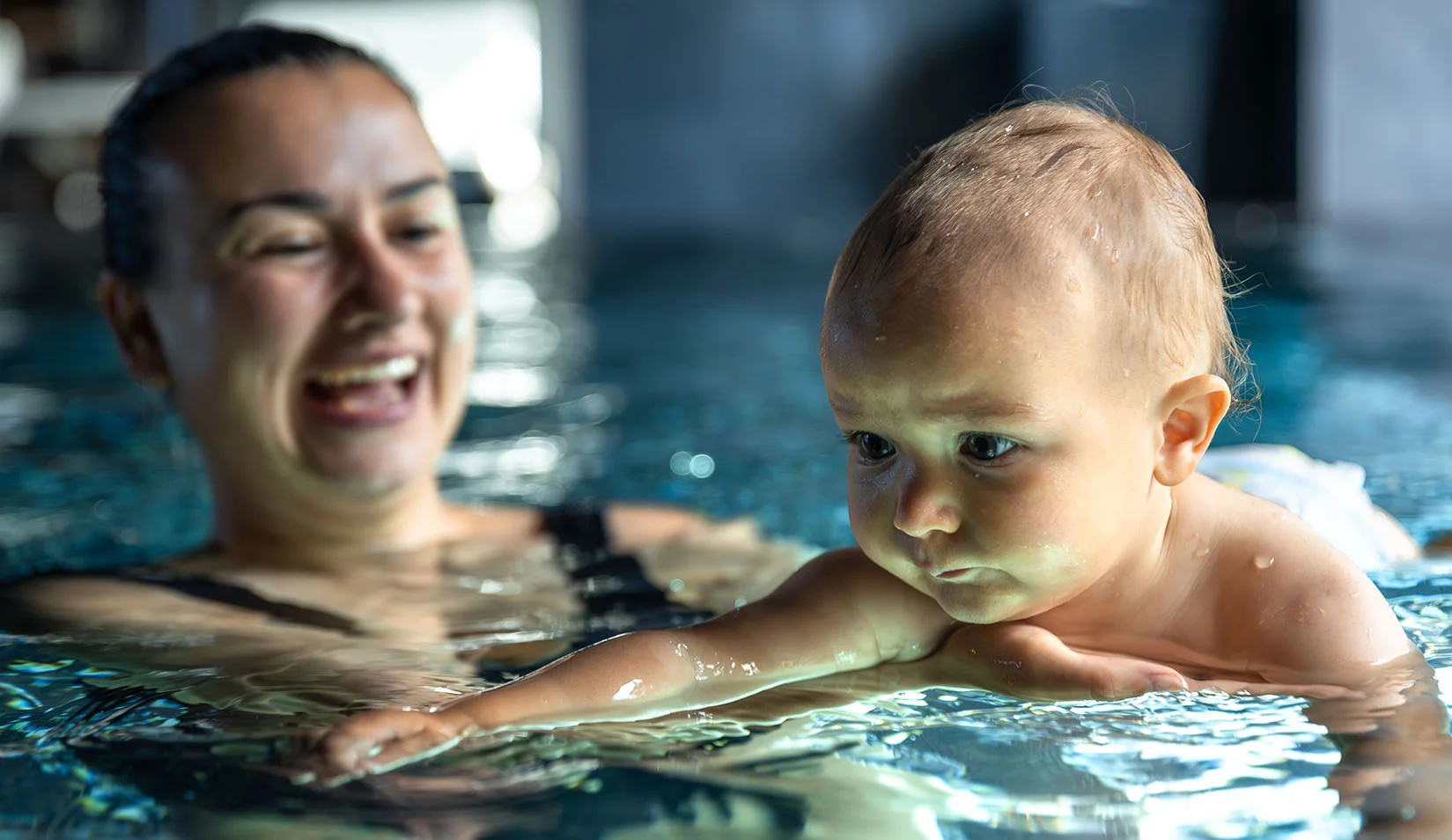
When selecting a program, it is essential to choose one tailored to the student’s specific age group. American Swim Academy’s specialized, small-group classes are designed for maximum comfort and steady progress.
Parent and Tot Classes for Infants and Toddlers
For our youngest swimmers — typically aged 6 months to 3 years — the water is a brand-new sensory world. Parent and child classes focus on water discovery, bonding, and building a positive attitude toward the pool.
In these classes, parents are in the water with their little ones, guided by an experienced instructor. Through gentle games, splashing, and structured play, babies learn to feel comfortable floating on their backs and having water poured gently over their heads.
These early interactions help toddlers develop basic coordination and water-positive habits. Our specialized curriculum for this age group, Our Programs – Water Adaptation, is designed to make this transition gentle, warm, and completely stress-free.
Independent Beginner Swim Lessons for Kids
Around age 3, many children are ready to transition into independent classes without a parent in the water. This is an exciting milestone that fosters self-reliance and confidence.
In preschool and school-age beginner classes, the focus shifts to independent water movement. Swimmers practice submerging their faces, gliding, and kicking across the pool with minimal assistance.
We structure these classes to keep kids engaged and motivated. By breaking down complex movements into fun challenges, we prevent frustration. If you are wondering when to start, read about the 3 Reasons to Get Your Child in Beginner Swim Lessons to understand how early instruction benefits physical development. You can also explore our specific class structures in Our Programs – Pre-School.
Adult Beginner Swim Programs
It is a common myth that swim lessons are only for children. In reality, many adults seek out beginner classes to build comfort in the water, prepare for vacations, or add a low-impact workout to their routine.
Adult beginner programs differ significantly from children’s classes. Instructors focus heavily on the psychological aspects of water comfort, explaining the physics of buoyancy and body positioning. There are no silly children’s games; instead, adults receive clear, respectful instruction on:
- Building deep-water confidence and mastering submersion.
- Learning to float effortlessly on the front and back.
- Developing efficient breathing patterns for basic strokes.
If you are an adult looking to take the plunge, read our article on Beginner Swimming Lessons for Adults: Why Sign Up to discover how empowering it is to learn this life-saving skill at any age.
Building Comfort and Confidence with Submersion
It is completely normal for a beginner — child or adult — to feel hesitant about putting their face in the water. This natural hesitation can be gently overcome with patience, play, and the right techniques.
One of our favorite tools for helping hesitant children is the “watering can” method. Instead of asking a child to submerge their head immediately, we use a colorful watering can to sprinkle water gently over their shoulders, then their hair, and finally their face. We often sing playful songs to keep the atmosphere light and positive.
Another common hurdle is the urge to rub the eyes immediately after getting wet, which often rubs chlorine or water in and causes discomfort. We teach children to blink their eyes rapidly like “windshield wipers” to clear the water naturally.
Progressive face submersion should be taken step-by-step:
- The Chin: Just dipping the chin into the water.
- The Mouth: Blowing bubbles with the mouth submerged.
- The Nose: Submerging up to the nose while blowing air out.
- The Eyes: Fully submerging with goggles on to look at a toy at the bottom of a shallow step.
We specialize in these gentle, paced methods. Our approach, detailed in Slow Easy Swim Lessons for Beginners, ensures that no child is forced beyond their comfort zone.
Comparing Group, Semi-Private, and Private Lessons
When enrolling in beginner swim lessons, parents and adult students must choose the format that best fits their budget, schedule, and learning style.
| Lesson Type | Student-to-Teacher Ratio | Best For | Key Advantages |
|---|---|---|---|
| Group Lessons | 4:1 | Social learners, building confidence alongside peers | Cost-effective, teaches observation skills, fun peer environment |
| Semi-Private | 2:1 | Siblings or friends of similar skill levels | High individual attention with a social element |
| Private Lessons | 1:1 | Hesitant beginners, rapid skill progression | Custom pacing, 100% focused attention, flexible scheduling |
If your child needs continuous, year-round instruction with a highly consistent schedule, a dedicated year-round program is often the ideal choice. This ensures they build on their skills week after week without losing progress during the off-season.
Comparing different private and semi-private structures can help you find the perfect match for your family’s needs, ensuring your child gets the individual attention necessary to thrive.
Frequently Asked Questions About Beginner Swim Lessons
What are the prerequisites for enrolling in a beginner class?
For a true Level 1 beginner class, there are absolutely no prerequisites! You do not need any prior swimming experience, and your child does not even need to be comfortable putting their face in the water yet.
In American Swim Academy beginner classes, our goal is simply to start wherever the student is comfortable and build skills from there.
How long does it take to progress to the next level?
Swim progression is non-linear and varies wildly from person to person. On average, it can take anywhere from 8 to 12 consistent lessons for a young beginner to move from absolute water acclimation to independent floating and basic kicking.
It is incredibly common — and completely normal — for a student to repeat a beginner level multiple times. Mastering foundational safety skills takes time, and rushing to the next level before these skills are second nature can actually stall progress. This is why we utilize a continuous enrollment model rather than short, seasonal blocks, allowing students to progress naturally at their own pace without pressure.
What should I look for in a qualified swim program?
When shopping around for the perfect swim school, keep these three essential factors in mind:
- Caring, Certified Instructors: Ensure the coaches are certified in CPR, First Aid, and Lifeguarding, and are specifically trained to work with hesitant or young beginners.
- Warm Water Temperatures: Shivering muscles tense up, making it nearly impossible to relax and float. Look for indoor pools heated to at least 90 degrees. Our pools are kept at a cozy 92°F year-round to ensure absolute comfort.
- Small Class Sizes: A low student-to-teacher ratio (such as 4:1) ensures your child receives the safety supervision and individual attention they deserve.
Conclusion
Learning to swim is a beautiful, life-changing journey that opens the door to a lifetime of water fun and safety. By choosing a program that prioritizes a gentle, confidence-first approach, you ensure that your child’s first memories of the pool are filled with joy, warmth, and success.
At American Swim Academy, we have spent decades helping Bay Area families build water confidence. Our year-round indoor swim lessons are held in warm, 92-degree heated pools designed specifically to help beginners relax and learn. With convenient locations in Fremont, Newark, Livermore, Dublin, and Walnut Creek, CA, we make it easy to fit consistent, high-quality instruction into your family’s busy schedule.
Are you ready to take the first step? Head over to our Get Started page to find a class, or explore the details of our beginner curriculum at Our Programs – Beginners. We cannot wait to welcome you and your little ones to the pool!