

Why Finding the Right Adult Swim Program Actually Matters
Adult swim lessons swimming programs come in more varieties than most people realize — and picking the wrong one wastes your time, money, and motivation.
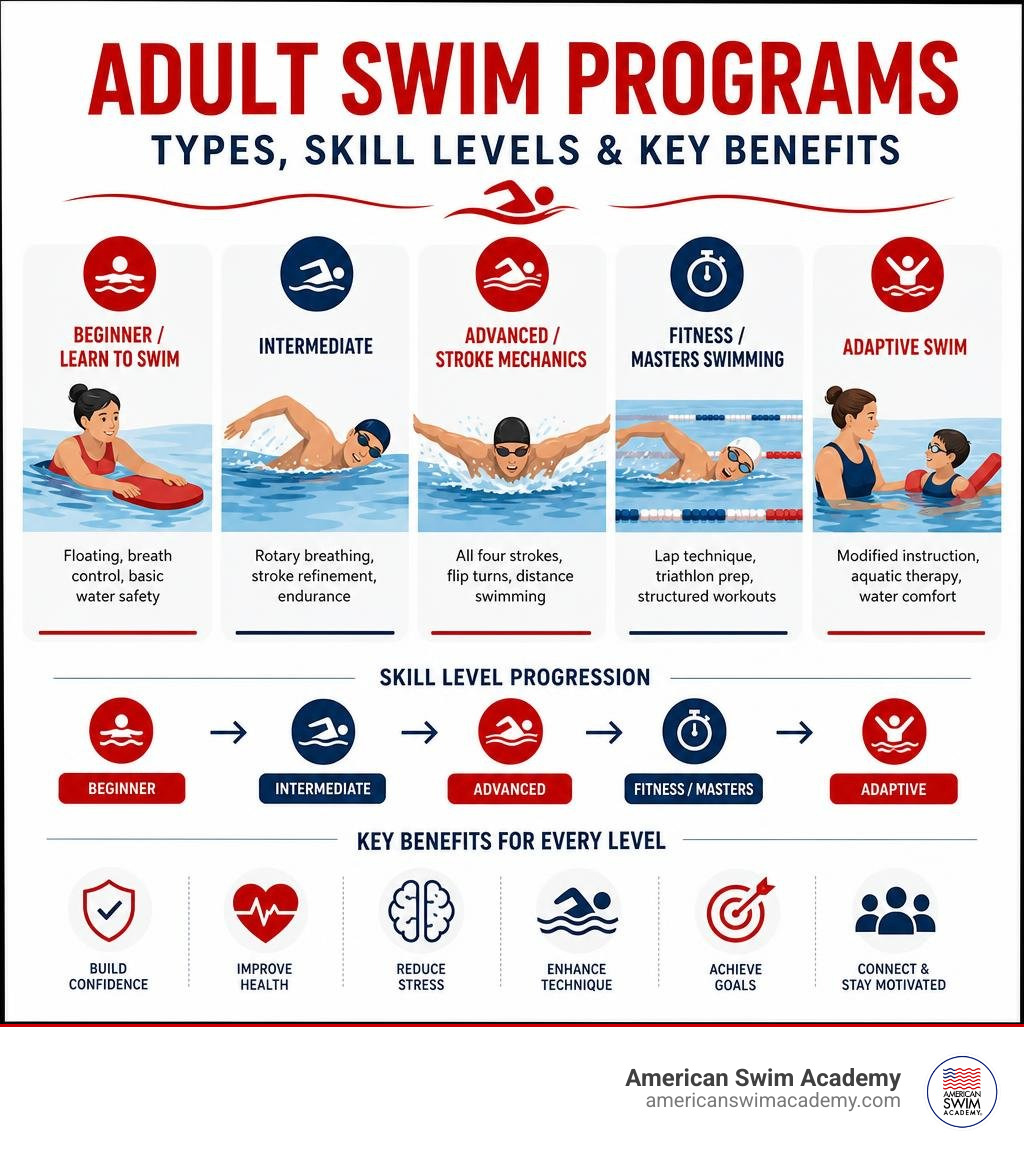
Here’s a quick overview of the main program types so you can find your fit fast:
| Program Type | Who It’s For | What You’ll Learn |
|---|---|---|
| Beginner / Learn to Swim | Non-swimmers or those with water anxiety | Floating, breath control, basic water safety |
| Intermediate | Can swim short distances but lack confidence | Rotary breathing, stroke refinement, endurance |
| Advanced / Stroke Mechanics | Competent swimmers | All four strokes, flip turns, distance swimming |
| Fitness / Masters Swimming | Adults training for health or competition | Lap technique, triathlon prep, structured workouts |
| Adaptive Swim | Adults with disabilities or special needs | Modified instruction, aquatic therapy, water comfort |
Whether you’re a parent who never learned to swim as a kid, someone rebuilding confidence after a scary water experience, or an athlete looking to add laps to your training — there’s a structured program designed for exactly where you are right now.
The good news? It’s never too late to start. Reputable water safety organizations and private swim schools all offer adult-specific programs that are paced differently from children’s lessons — because adults learn differently, full stop.
This guide walks you through how to compare your options clearly, so you don’t have to guess.
Understanding the Landscape of Adult Swim Lessons Swimming Programs
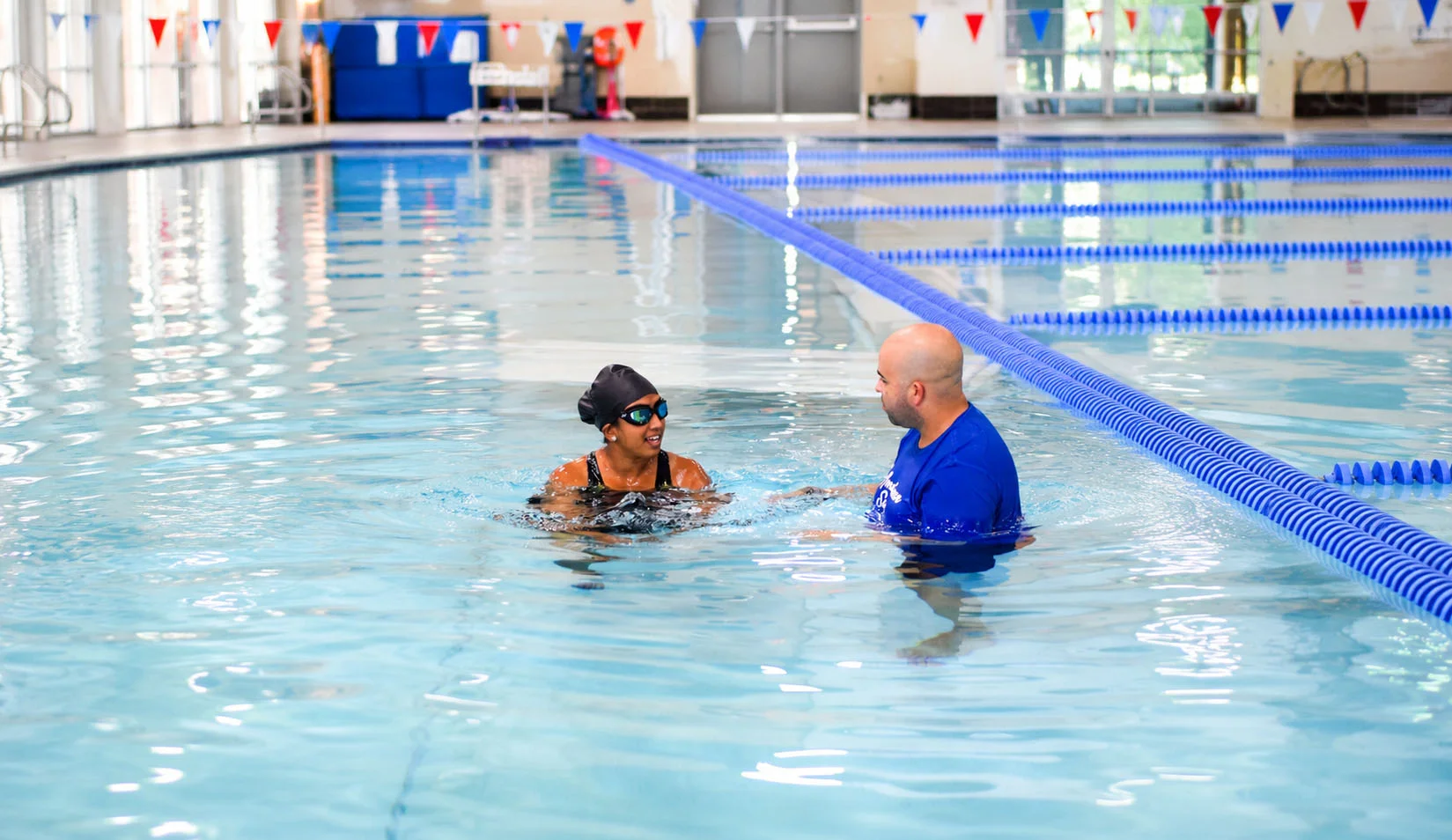
When you begin searching for the ideal aquatic program, the sheer volume of choices can feel overwhelming. From community centers to dedicated private academies, the structures of adult swim lessons swimming programs vary widely. Understanding how these programs are categorized is the first step toward making an informed decision.
Generally, adult swim curricula are divided into progressive tiers. For instance, standard adult learning programs categorize instruction into simple, self-paced phases: learning the basics, improving skills and strokes, and swimming for fitness. High-quality programs utilize a granular framework that guides swimmers from basic water acclimation all the way to advanced stroke mechanics and endurance.
In the San Francisco Bay Area—especially around Fremont, Newark, Livermore, Dublin, and Walnut Creek—local options range from public municipal programs to specialized private schools. Some swimmers look to local community classes, while others seek year-round, indoor facilities that offer consistent water temperatures and highly specialized instruction. To explore what a dedicated private program looks like, you can Learn more about adult swim lessons at our warm, indoor facilities.
Regardless of where you choose to dive in, a great program will prioritize your individual comfort and physical safety. High-quality programs structure their classes to ensure that you never feel rushed. Instead of forcing everyone through a rigid timeline, the best adult swimming lessons allow you to master one benchmark—such as comfortably submerging your face or treading water—before moving on to more complex movements.
Beginner Adult Swim Lessons Swimming Programs
For many adults, the hardest part of learning to swim is simply taking the first step into the water. If you feel nervous or have avoided the deep end for years, beginner-focused adult swim lessons swimming programs are designed specifically for you. These classes do not expect you to know how to kick, glide, or even float. Instead, they start at the absolute beginning.
The primary goals of a beginner program are water acclimation and building foundational comfort. You will spend your first few sessions learning how to breathe comfortably in the water. This includes practicing basic breath control, such as blowing bubbles and submerging your mouth, nose, and eventually your eyes. Instructors will guide you through gentle front and back glides, teaching you how the water naturally supports your body weight.
Overcoming a fear of the water is a deeply personal journey, and having the right environment makes all the difference. At American Swim Academy, we teach our classes in indoor pools heated to a warm, comfortable 92 degrees. This warm water is crucial for beginners because cold water naturally causes muscles to tense up, which can heighten anxiety. When the water feels like a warm bath, your body relaxes, making it much easier to learn how to float and control your breathing. If you are ready to take that initial step, reading more about Beginner swimming lessons for adults can help you understand the physical and emotional benefits of starting this rewarding journey.
Intermediate and Advanced Adult Swim Lessons Swimming Programs
Once you can comfortably submerge your head, float on your front and back without assistance, and swim a basic dog paddle or front crawl for a short distance, you are ready to transition to intermediate and advanced instruction. These programs shift the focus from simple survival and water comfort to efficiency, technique, and stamina.
In an intermediate class, the major hurdle is often mastering rotary breathing. Many self-taught adult swimmers can swim a lap or two, but they find themselves completely out of breath because they have to lift their entire head out of the water to inhale. Intermediate lessons teach you how to roll your body and turn your head to the side to breathe seamlessly without disrupting your forward momentum. You will also begin refining the front crawl (freestyle) and back crawl, and you’ll be introduced to the foundational movements of the breaststroke and butterfly.
For advanced swimmers, the focus shifts to fine-tuning stroke mechanics and building serious cardiovascular endurance. Advanced classes are excellent for lap swimmers who want to prevent shoulder injuries, triathletes preparing for an open-water swim, or adults who want to use swimming as their primary form of high-intensity, low-impact cardio. You will work on advanced skills like flip turns, bilateral breathing, and pacing strategies. If you want to refine your existing skills or train for a specific fitness goal, exploring Advanced Adult Swim Lessons can help you take your stroke technique to the next level.
Key Differences Between Adult and Youth Swim Programs
It is a common misconception that adult swim lessons are simply children’s lessons delivered to taller people. In reality, the teaching methodology, physical conditioning, and psychological approach must be entirely different to be effective.
First, consider cognitive learning vs. intuitive learning. Children tend to learn intuitively through play, imitation, and repetition. They don’t need to understand the physics of buoyancy to float; they just copy the instructor. Adults, on the other hand, learn analytically. We want to understand why a movement works. A great adult instructor will explain the mechanics of body alignment, how head position affects the hips, and how water resistance works.
Second, pacing and fear dynamics differ significantly. While children can also be afraid of the water, adult fear is often deeply ingrained, sometimes stemming from decades of avoiding the pool or surviving a traumatic childhood near-drowning incident. Adults require a highly respectful, self-paced progression where they maintain a sense of control over their movements. Instructors communicate with adults as peers, establishing mutual trust before asking them to perform challenging skills.
Finally, physical conditioning and body mechanics are distinct. Adults have different center-of-gravity distributions, muscle densities, and joint flexibilities compared to children. For example, adult ankles are often much stiffer than children’s ankles, which affects kick efficiency. Adult programs adapt to these physical realities, focusing on core stabilization and modified kicking techniques to maximize efficiency.
| Feature | Youth Swim Programs | Adult Swim Programs |
|---|---|---|
| Learning Style | Intuitive, game-based, imitative | Analytical, conceptual, goal-oriented |
| Fear Management | Addressed through play and distraction | Addressed through logic, peer support, and gradual exposure |
| Physical Focus | Developing basic motor skills and coordination | Adapting to existing joint flexibility and building stamina |
| Communication | Simple, imaginative directions | Peer-to-peer, detailed anatomical explanations |
| Class Pacing | Group-synchronized progression | Self-paced, highly individualized goal-setting |
Specialized Aquatic Programs for Diverse Adult Needs
Beyond standard beginner and advanced tracks, there are specialized aquatic programs tailored to meet highly specific adult needs. Swimming is not a one-size-fits-all activity, and the modern landscape of adult aquatics reflects this diversity.
One major area of specialization is water anxiety and aquaphobia programs. These classes are often conducted in very small groups or private one-on-one sessions. The goal is not to teach beautiful freestyle technique, but to help the swimmer feel safe, grounded, and in control. Instructors use gentle exposure therapy techniques, allowing students to stand in shallow water, practice relaxed breathing, and gradually learn to trust their natural buoyancy.
For those looking for a community-centered approach to fitness, structured group tracks can transition adults from basic immersion to lap swimming. These programs often feature specialized classes to help swimmers target specific strokes, build cardiovascular endurance, and connect with other adult learners.
Additionally, many adults seek out programs for triathlon preparation and lap swimming. Swimming is often the most daunting leg of a triathlon for multi-sport athletes. Specialized stroke clinics help these swimmers transition from the calm environment of a pool to the unpredictable conditions of open water, teaching them how to sight (look ahead while swimming) and maintain a straight line.
For adults with physical limitations, injuries, or chronic joint pain, adaptive swim programs offer an incredible, low-impact way to exercise. Because water supports up to 90% of your body weight, it reduces stress on the joints, allowing for a wider range of motion and pain-free movement. If you are ready to find a program that accommodates your unique goals, you can explore the options available in the Bay Area and see how to get started with Adult Swim Lessons at American Swim Academy.
What to Expect: Class Formats, Ratios, and Policies
Before you register for your first session, it is helpful to know what to expect regarding class logistics, instructor ratios, and common policies. Knowing these details ahead of time helps prevent surprises and ensures you feel prepared from day one.
- Class Ratios and Formats: Group classes for adults typically maintain small student-to-instructor ratios to ensure personalized attention. While some large municipal pools may have larger groups, premium private programs often limit adult classes to small, intimate groups. Private (one-on-one) and semi-private (one-on-two) lessons are also widely available for adults who want highly customized feedback or have tight schedules.
- Class Duration: Most adult swim lessons run for 45 to 60 minutes. This length of time is ideal because it allows for a proper warm-up, focused skill practice, and a cool-down without causing excessive muscle fatigue.
- Required Equipment and Gear: You don’t need a locker full of high-tech gear to start. For your first class, you will need a comfortable, secure swimsuit (avoid loose cotton clothing as it holds water and drags you down), a towel, and a pair of well-fitting swim goggles. If you have long hair, a silicone or latex swim cap is highly recommended to keep your hair out of your face and eyes while breathing. Most swim schools will provide training aids like kickboards, pull buoys, and safety belts during your lesson.
- Facilities and Water Temperature: The temperature of the pool can make or break your learning experience. Traditional lap lanes are often kept between 78 and 82 degrees, which is excellent for high-intensity training but can feel chilly when you are standing still learning to float. Private academies like ours feature indoor pools heated to 92 degrees year-round, ensuring you stay warm, relaxed, and focused on your skills.
- Registration and Cancellation Policies: Most swim schools operate on a monthly billing cycle or multi-week terms. It is important to review cancellation and makeup policies before committing. For example, some programs require a 24-hour notice to receive a class credit, while others offer flexible makeup tokens if you have to miss a class due to work or illness. To find a schedule and format that works for your busy life, you can view the full range of Our Programs to plan your aquatic journey.
Frequently Asked Questions About Adult Swim Programs
How do I know which skill level is right for me?
Determining your starting point is simple if you focus on a few key safety and comfort benchmarks. Ask yourself the following questions to help place yourself:
- Are you comfortable putting your face in the water and letting your feet leave the pool floor? If not, a beginner or water acclimation class is the perfect place to start.
- Can you float on your front and back for 10 seconds and swim 15 yards independently, but you struggle to breathe continuously? You belong in an intermediate class focusing on rotary breathing and basic stroke development.
- Can you swim multiple laps of freestyle and backstroke but want to learn breaststroke, butterfly, or build endurance for lap swimming? An advanced stroke mechanics or fitness-focused class is your best fit.
If you are still unsure, many swim schools offer quick, in-water assessments. You can also review our comprehensive FAQ page for more details on level placement and program structures.
What equipment do I need to bring to my first adult swim class?
You only need a few basic items to get started:
- A comfortable, athletic swimsuit: Choose something secure that allows you to move freely.
- Swim goggles: Goggles protect your eyes from chlorine and help you feel much more comfortable looking underwater.
- A swim cap: If you have medium to long hair, a cap keeps hair out of your mouth and goggles.
- A towel and deck shoes: Bring a warm towel for afterward and sandals or flip-flops to wear on the pool deck.
All specialized training gear, such as kickboards and flotation noodles, is typically provided by the facility.
Are there flexible scheduling or financial assistance options available?
Yes! Many adult programs understand that balancing work, family, and swim lessons can be challenging. Private swim schools often offer flexible scheduling, allowing you to choose evening or weekend classes that fit your routine.
For community-based options, national organizations frequently offer financial assistance or sliding-scale scholarships funded by donor campaigns, ensuring that water safety is accessible to everyone in the community. Additionally, quality adult programs offer various session lengths, makeup class policies, and proration options to accommodate busy adult lifestyles.
Conclusion
Learning to swim or refining your strokes as an adult is one of the most powerful investments you can make in your health, safety, and personal confidence. Swimming is a true lifelong fitness activity – it is incredibly gentle on your joints, offers a complete full-body workout, and provides a peaceful mental escape from the busyness of daily life.
More importantly, acquiring these skills is a vital safety measure. Drowning remains a significant public safety concern across all age groups, and being water-competent means you can protect yourself and confidently enjoy water activities with your family. The Centers for Disease Control and Prevention emphasizes that drowning prevention includes multiple layers of protection, including swimming skills, supervision, and appropriate safety equipment.
No matter your age, current skill level, or past experiences with water, there is a welcoming, supportive program waiting for you. If you live in the San Francisco Bay Area – including Fremont, Newark, Livermore, Dublin, or Walnut Creek – our team of caring, experienced instructors is ready to help you succeed in our warm, comfortable 92-degree pools.
When you are ready to take the plunge, you can Get Started with us today, or visit our program page to Sign up for Adult Swim Lessons and begin your journey to becoming a confident, lifelong swimmer.