

Why Indoor Pool Swim Classes Are Worth It Year-Round
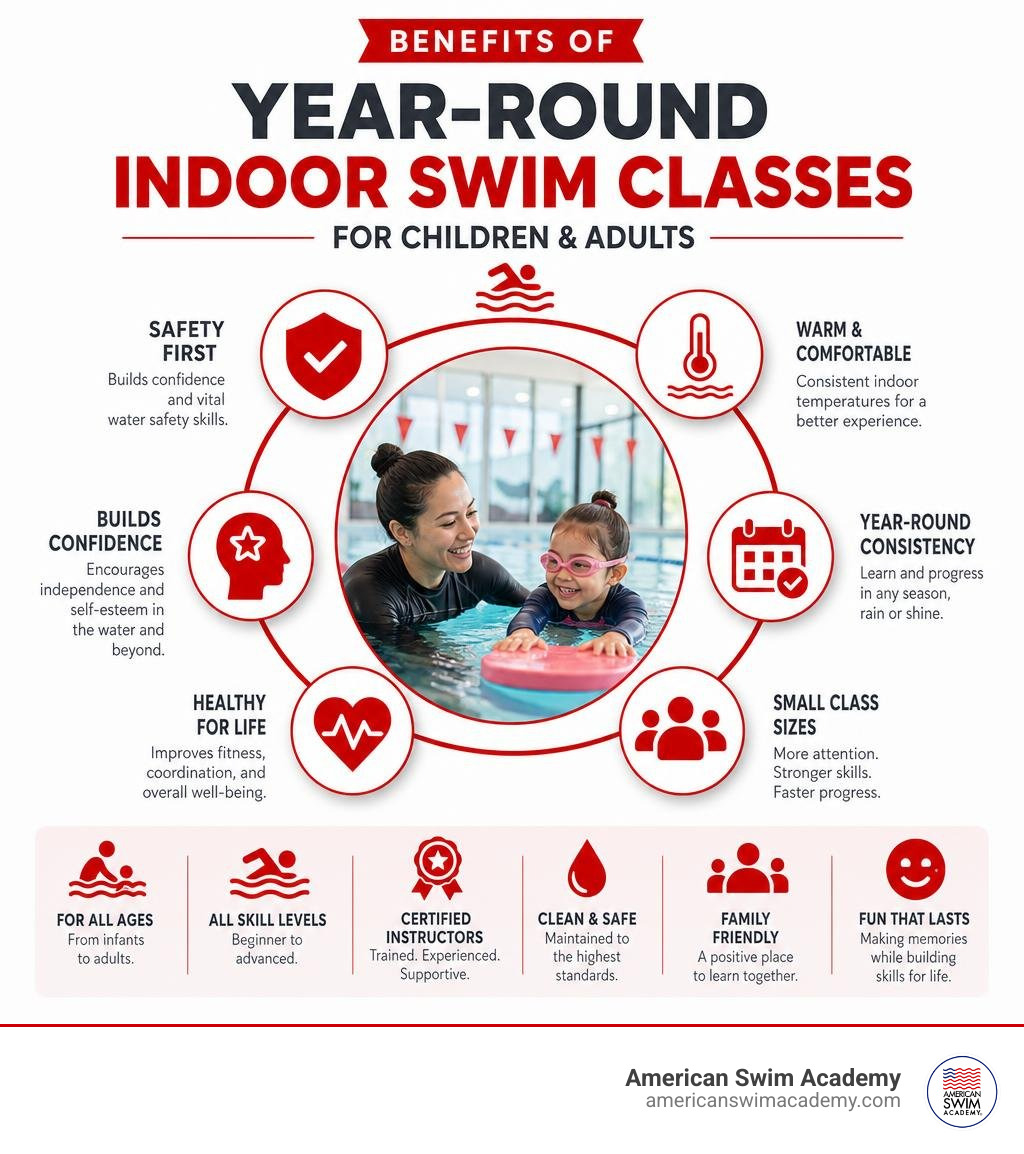
Indoor pool swim classes give children and adults a safe, warm, and consistent place to learn one of life’s most important survival skills — no matter the weather or season.
Quick answer: What are indoor pool swim classes?
| Type | Ages | Best For |
|---|---|---|
| Parent-Tot | 4 months – 3 years | Water intro with caregiver |
| Preschool | 3 – 5 years | Early independence, basic skills |
| Learn-to-Swim | 5 – 12 years | Stroke development, water safety |
| Teen / Adult | 13+ | Beginner comfort or stroke refinement |
| Adaptive / Special Needs | All ages | Personalized pace, sensory-friendly options |
| Aquafitness | Adults | Low-impact fitness in the water |
Drowning is one of the leading causes of accidental death in children — yet it is largely preventable. Learning to swim early makes a real difference.
For busy Bay Area parents, indoor pools solve a lot of problems at once. Classes run year-round. Water temperatures stay warm and consistent, which matters especially for young children and swimmers with sensory sensitivities. And small group sizes mean your child gets actual attention from an instructor, not just a spot in a crowded lane.
Whether you have a nervous toddler, a child with autism, or you’re an adult who never learned to swim — there’s a structured indoor program designed for exactly where you are right now.
Core Types of Indoor Pool Swim Classes
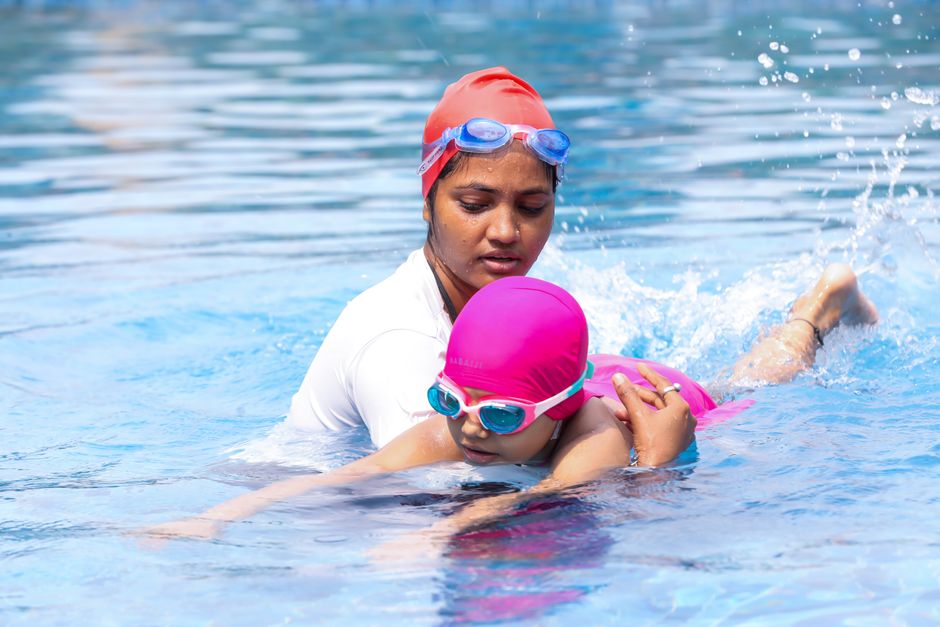
When looking for indoor pool swim classes, you will quickly find that the best programs do not believe in a one-size-fits-all approach. Swimmers of different ages have entirely different physical, emotional, and cognitive needs. A structured, progressive curriculum ensures that every swimmer starts at a level that builds water confidence first, followed by safety skills, and finally, advanced stroke techniques.
By meeting age-appropriate milestones, swimmers can progress naturally without feeling overwhelmed. Let’s break down the primary types of indoor aquatic programs you will encounter.
Parent-Tot and Preschool Indoor Pool Swim Classes
For our youngest swimmers, the journey begins with water adaptation. These early-childhood classes are divided into two primary stages: parent-assisted lessons and independent preschool classes.
In parent-assisted classes, which typically welcome infants from 4 to 36 months, the goal is to build water comfort and teach basic safety habits. Parents or guardians join their babies in the warm water, guided by an instructor. Together, they practice gentle water entry, blowing bubbles, floating on the back, and basic kicking.
These sessions are highly focused on bonding and removing any fear of the water. To make these early experiences accessible, some premium programs even offer special promotions, such as letting babies under 8 months swim for free in weekday daytime classes. For more information on how we help young ones get comfortable in the pool, explore our guide to Water Adaptation.
Once a toddler reaches around 3 years of age, they are usually ready to transition to independent classes. Our Pre School classes (designed for ages 3 to 5) focus on building early independence. In these classes, children learn to submerge their faces, practice air exchange, glide, and perform basic paddling without a parent in the water.
Because safety is the absolute priority at this stage, class ratios must remain incredibly small. While municipal standards might allow larger groups, premier private programs keep preschool ratios as low as 2:1 or 3:1 to ensure every child is supervised and supported at all times.
Learn-to-Swim and Advanced Indoor Pool Swim Classes
As children reach school age (typically 5 years and older), they transition into formal learn-to-swim programs. This is where independent swimming, technical stroke development, and safety skills come together.
For beginners, the focus is on mastering the fundamentals. Swimmers learn to jump into deep water, return to the surface, float independently, and swim to the safety of the pool wall. If your child is just starting out, you can learn more about our foundational classes by visiting our page for Beginners.
Once these core survival skills are locked in, the curriculum shifts toward stroke development. Swimmers are progressively taught the four primary competitive strokes in a structured order:
- Freestyle (front crawl)
- Backstroke
- Breaststroke
- Butterfly
As they master each stroke, they move on to our Intermediate & Advanced levels. Here, the focus shifts to endurance building, distance swimming, and advanced mechanics.
For those looking to take their skills to the next level, we offer Stroke Training & Elite Swimmers classes. These sessions prepare swimmers for competitive swim teams or advanced water safety certifications by refining flip turns, streamline starts, breathing patterns, and stroke efficiency.
Young Adult and Adult Indoor Swim Programs
It is a common misconception that swim lessons are only for young children. In reality, a significant percentage of adults cannot swim a single length of a pool comfortably. Whether you are a teenager looking to catch up with your peers or an adult who has harbored a lifelong fear of deep water, dedicated indoor programs are available for you.
Our Young Adult Programs cater to teens who want to learn to swim or refine their strokes in a supportive environment surrounded by peers of a similar age.
For older learners, our Adult Programs provide goal-oriented instruction tailored to your individual pace. Adult classes generally fall into three categories:
- Beginner Comfort: Overcoming water anxiety, learning to float, and mastering basic breathing.
- Stroke Development: Learning freestyle and backstroke for fitness or recreation.
- Stroke Refinement & Training: Preparing for triathlons, improving lap swimming endurance, or mastering advanced techniques.
Adult lessons are kept small—often limited to five or fewer participants—ensuring a highly supportive and judgment-free learning environment where you can focus on your personal aquatic goals.
Key Differences Between Public Municipal Pools and Private Swim Schools
When deciding where to enroll in indoor pool swim classes, parents in the Bay Area generally choose between public municipal programs and private swim schools. Both options have their place, but they differ significantly in class sizes, water temperature, facility design, and overall scheduling flexibility.
| Feature | Public Municipal Programs | Private Swim Schools (e.g., American Swim Academy) |
|---|---|---|
| Water Temperature | Typically 78°F – 84°F (designed for lap swimmers) | Warm 92°F (designed for comfort and learning) |
| Student-to-Teacher Ratio | Larger ratios (often 1:6 to 1:10) | Small ratios (1:1, 2:1, or max 4:1) |
| Scheduling | Rigid seasonal blocks (Spring, Summer, Fall) | Year-round, flexible monthly scheduling |
| Pool Environment | Large, shared multi-use facilities | Dedicated, climate-controlled indoor facilities |
| Viewing Areas | Often distant bleachers or outdoor viewing | Heated indoor viewing galleries with glass partitions |
Class Sizes, Ratios, and Curriculum Standards
The single biggest factor in how quickly a swimmer progresses is the student-to-instructor ratio.
Municipal programs, such as those offered through local parks and recreation departments, are excellent budget-friendly options. However, because they serve large communities, they often have larger class sizes. It is not uncommon to see one instructor managing six to ten children at once. In these larger groups, children spend a significant portion of their 30-minute lesson sitting on the pool steps waiting for their turn.
In contrast, private swim schools prioritize personalized attention. At American Swim Academy, our Swimming Lessons are built around small group sizes.
Private lessons (1:1 ratio) provide completely customized instruction, which is ideal for children with intense water anxiety or those needing rapid progress. Semi-private lessons (2:1 ratio) offer an excellent balance, allowing two siblings or friends of similar skill levels to learn together while receiving constant feedback.
With smaller ratios, students spend more time actively swimming, which builds muscle memory and water confidence much faster.
Facility Amenities, Water Temperature, and Viewing Areas
The physical environment of the pool plays a massive role in a swimmer’s success, particularly for beginners and young children.
Most municipal indoor pools are designed as multi-use facilities. Because they host lap swimmers, swim teams, and high-impact aquafitness classes, their water temperatures are typically kept cool—usually between 78°F and 84°F. While this temperature is perfect for an active lap swimmer, it can cause young children to shiver, turn blue, and lose focus within minutes.
Private swim schools design their facilities specifically for swim instruction. Our indoor pools are heated to a warm, comfortable 92°F, and the surrounding air is climate-controlled to prevent post-swim chills. Warm water relaxes tense muscles, reduces anxiety, and allows children to focus entirely on their instructors.
Additionally, premier private facilities feature:
- Large, clean family changing rooms designed to make transitioning in and out of swimsuits stress-free.
- Comfortable, climate-controlled viewing galleries with large glass windows, allowing parents to watch every milestone without sitting in a humid pool deck environment.
- State-of-the-art water purification systems that exceed standard public health requirements.
To learn more about how we maintain clean, comfortable, and safe learning environments, read about our commitment to Health and Safety.
Safety Standards, Admission Policies, and Registration Logistics

Enrolling in indoor pool swim classes requires an understanding of how facilities manage safety, level placement, and administrative logistics. Whether you are swimming at a municipal facility or a private academy, strict guidelines are in place to ensure a safe environment for everyone.
Supervision, Safety Protocols, and Student Safety
Water safety is the foundation of every program. In the Bay Area, public and private facilities enforce strict supervision ratios to keep children safe.
As a general rule across California aquatic facilities, children under the age of 5 must have a parent or guardian within arm’s reach at all times when in the water during recreational swim times. During structured lessons, this responsibility shifts to the certified instructor, but parents are still required to remain on-site.
All reputable swim schools employ instructors who are fully certified in CPR, First Aid, and water safety instruction. On-deck lifeguards are also present to provide an extra layer of safety.
Furthermore, high-quality programs integrate water safety education directly into every single lesson. Rather than just teaching strokes, instructors teach kids how to handle real-world scenarios, such as falling into a pool fully clothed, finding air, and safely climbing out without using a ladder.
Finding the Right Level and Getting Assessed
Registering your child for the wrong level can lead to frustration, anxiety, or safety risks. If a child is placed in a class that is too advanced, they may become overwhelmed; if the class is too basic, they may lose interest.
To prevent this, families can utilize several tools:
- Online Level Placement Questionnaires: Interactive step-by-step tools that ask about your child’s age, past swim experience, and specific water skills to recommend the perfect starting point.
- In-Pool Swim Assessments: Many private swim schools offer free, quick in-water assessments where an instructor evaluates your child’s comfort and skills in real-time.
- Progress Report Cards: Throughout their swim journey, students receive regular evaluations. These report cards track specific skill benchmarks, making it easy to know exactly when a child is ready to graduate to the next level.
If you are looking to enroll a public school or community group, municipal facilities like the Swim Lessons | City of Fremont, CA Official Website offer structured local programs, while private schools provide seamless, personalized assessments.
Fees, Surcharges, and Refund Policies
Pricing and registration structures vary depending on the type of program you choose.
Municipal programs often charge per session (typically a 4-to-8-week block). Some cities apply a non-resident surcharge (often around 20%) if you live outside the municipal boundary.
Private swim schools usually operate on a monthly tuition model, which provides continuous, year-round instruction without the stress of re-registering every few weeks. This continuous model prevents “skill regression”—a common issue where children forget what they learned during long breaks between seasonal sessions.
When registering, it is important to review the facility’s refund and transfer policies. Many community centers charge an administrative processing fee (often 10%) for cancellations or class transfers. Private academies typically offer more flexible transfer options, allowing you to change your class day or time online if your family’s schedule changes.
Managing Pool Space, Waitlists, and Schedules
Because indoor swim classes are highly popular, managing pool space and schedules is a finely tuned process.
To comply with local health regulations, facilities must balance recreational swimming, lane swimming, and structured lessons. This means that during peak lesson times, the pool may be divided into designated zones using lane ropes to keep swimmers separated and safe.
If a class you want is full, you can join a waitlist. High-quality swim schools monitor these waitlists closely and will often open new classes or add instructors if demand for a specific level is high.
For families looking for flexible options, some municipal facilities, such as The Wave Swim Lessons | Dublin Aquatic Center, CA , provide seasonal flex sessions, while private schools offer year-round, consistent scheduling to fit into your busy life.
Frequently Asked Questions About Indoor Swimming Lessons
What should my child wear if they are not toilet trained?
To maintain strict pool hygiene and prevent unscheduled pool closures, all facilities enforce a strict diaper policy. Children who are not fully toilet trained must wear a reusable swim diaper or a disposable swim diaper under a snug-fitting plastic pant or swimsuit. Regular diapers are not allowed in the pool because they absorb water, swell up, and fall apart, creating a safety and hygiene hazard.
Can I take photos or videos during indoor swim lessons?
To protect the privacy and safety of all children, most indoor pools have strict camera and cell phone policies. Photography and video recording are strictly prohibited in changing rooms and restrooms. On the pool deck, you may be allowed to take photos or videos of only your own child, but you must obtain permission from the pool coordinator or deck supervisor first.
What adaptive options are available for swimmers with special needs?
Swimming is an incredibly therapeutic and beneficial activity for individuals with physical, cognitive, or sensory disabilities. Many private swim schools and select municipal programs offer adaptive swim lessons.
These classes feature highly trained instructors who adapt their teaching styles to match the unique needs of each swimmer. Private 1:1 lessons are highly recommended for diverse learners, as they allow for a sensory-friendly, quiet, and personalized learning pace.
Conclusion
Enrolling in indoor pool swim classes is one of the greatest investments you can make in your child’s safety, health, and confidence. By choosing a program that offers warm water, small class sizes, and a progressive curriculum, you ensure that learning to swim is a fun, positive experience.
At American Swim Academy, we are dedicated to building confident, safe swimmers for life. With our 92° heated indoor pools, small class sizes, and caring, experienced instructors, we provide the perfect environment for your family to dive in year-round.
Ready to start your swim journey? Explore Our Programs to find the perfect fit, check out our convenient Bay Area Locations, or Get Started with registration today.
No matter where you start, the most important step is simply getting in the water. For more information on our introductory classes, visit our specialized page for Beginners and let’s make a splash together!