

Why Swimming Classes for Infants Could Be One of the Most Important Decisions You Make
Swimming classes for infants are structured water programs designed to introduce babies and toddlers to the water safely — building comfort, basic survival skills, and a foundation for lifelong water confidence.
Quick answer: What to know about infant swim classes
- Who they’re for: Babies as young as 4-6 months old (some programs accept infants from 6 weeks)
- Main types: Parent-tot play-based classes and survival-focused one-on-one programs (like ISR or ISS)
- Core skills taught: Floating, breath control, submersion comfort, and the swim-float-swim sequence
- How long: Sessions range from 10 to 30 minutes, held weekly or multiple times per week
- Key benefit: Formal swim lessons can improve water safety outcomes for children by up to 88%
- What to look for: Certified instructors, warm water (87–94°F), small class sizes, and age-appropriate teaching methods
Water safety and confidence are top priorities for families with young children. Research shows that proactive water education provides an essential layer of protection, helping children build a secure and happy relationship with the water during family gatherings or daily routines.
That’s exactly why, as of June 2026, more Bay Area parents are enrolling their babies in swim programs earlier than ever.
Early swim lessons aren’t about turning your infant into a competitive swimmer. They’re about equipping your child with essential water safety skills, building confidence, and establishing a foundation of water comfort that pays off for years to come.
Understanding the Types of Swimming Classes for Infants
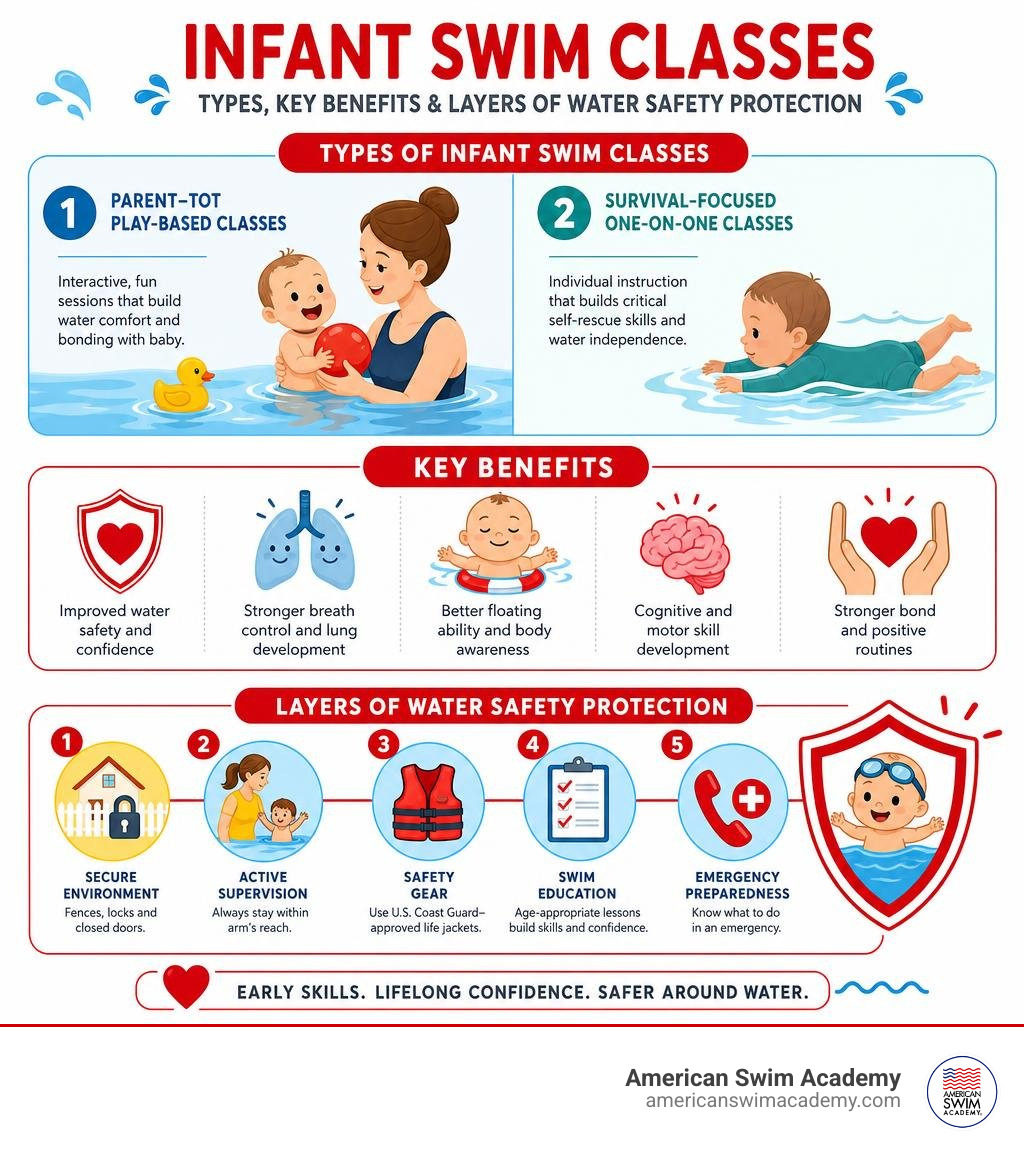
When you begin searching for swimming classes for infants in the Bay Area, you will quickly realize that not all programs are created equal. Different schools approach early aquatic education from vastly different philosophies. Finding the right fit depends on your child’s temperament, your family’s lifestyle, and your primary goals for their time in the pool.
Generally, infant swim programs fall into two main categories: parent-child play-based classes and survival-focused training. Some programs focus heavily on emotional comfort and bonding, while others prioritize rapid self-rescue skill acquisition.
To help you visualize how these approaches differ, we have broken down their core characteristics in the table below:
| Feature/Criteria | Parent-Tot & Play-Based Classes | Survival-Focused Training (ISR/ISS) |
|---|---|---|
| Primary Focus | Water comfort, bonding, and sensory play | Self-rescue and immediate water survival |
| Class Size | Small groups (typically 4 to 10 parent-child pairs) | One-on-one (only the child and instructor) |
| Parent in Water | Yes, parent actively guides and bonds with the infant | No, parents watch from the pool deck |
| Session Length | 25 to 30 minutes | 10 minutes (highly intensive) |
| Key Milestones | Supported floating, breath control, and water play | Rollback to float, swim-float-swim sequence |
| Frequency | 1 to 3 times per week, often year-round | 5 days a week for 4 to 6 weeks |
Parent-Tot and Play-Based Swimming Classes for Infants
Parent-tot and play-based classes are built around a simple truth: babies learn best when they feel completely safe, loved, and engaged. In these classes, you are right there in the pool with your child, acting as their primary source of trust and support.
Through a structured curriculum of songs, sensory games, and gentle water movements, infants learn to view the pool as a happy, non-threatening environment. Instructors guide you through proper holds and techniques to help your baby experience buoyancy, practice kicking, and develop early breath control.
This approach is highly effective for reducing early water anxiety and establishing a positive association with swimming that lasts a lifetime. Beyond safety, these classes offer a beautiful opportunity to unplug from daily distractions and bond with your little one in a warm, relaxing setting.
Learn more about how baby swim lessons are fun for baby and parents to discover how joy and learning go hand in hand in the water.
Survival-Focused Swimming Classes for Infants
On the other end of the spectrum are survival-focused programs, often referred to as Infant Swimming Resource (ISR) or Infant Survival Swim (ISS). These programs are highly structured, intensive, and designed with one primary objective: teaching an infant how to float and breathe comfortably if they enter a body of water unassisted.
In a survival program, the parent does not enter the water. Instead, a certified specialist works one-on-one with the infant in short, 10-minute sessions. These sessions are kept brief to match a baby’s limited attention span and prevent physical fatigue.
Through precise, repetitive physical conditioning, infants as young as six months are taught to roll from a face-down position onto their backs to float, rest, and breathe until help arrives. Older toddlers learn the “swim-float-swim” sequence, where they swim a short distance, roll onto their backs to rest, and then flip over to continue swimming toward safety.
If you are looking for highly specialized safety programs in the East Bay, you can explore local options. For instance, parents can Find infant swim classes at our Dublin, CA location to see how we blend essential safety skills with a nurturing environment.
The Developmental and Safety Benefits of Early Swim Lessons
Enrolling your child in swimming classes for infants does far more than prepare them for a safe summer at the pool. The physical, cognitive, and emotional benefits of early water exposure are backed by extensive developmental research.
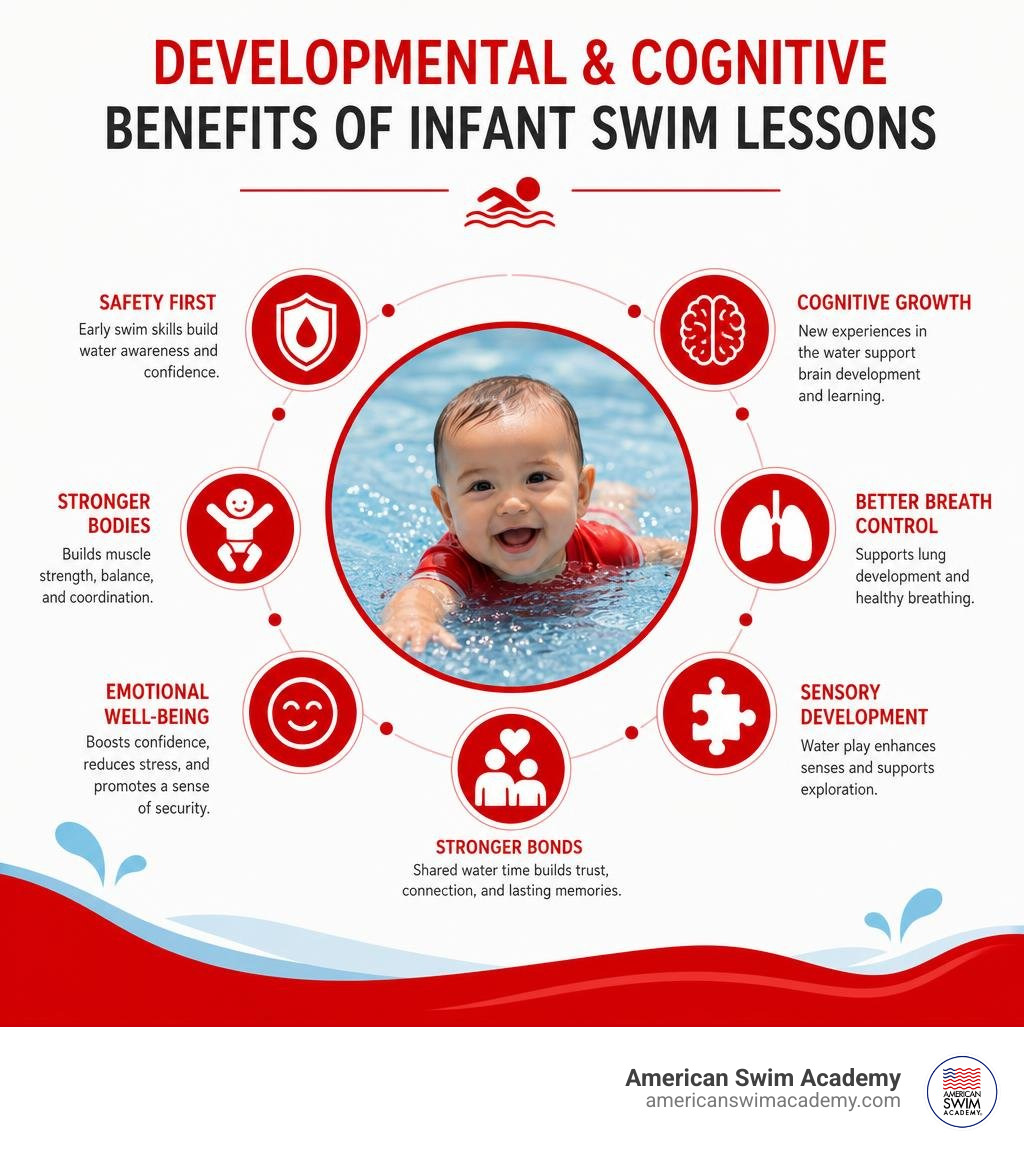
First and foremost is proactive water safety. Because water competency is a vital skill for toddlers, early training acts as a critical layer of protection, helping children navigate the water with confidence. Studies show that formal swimming lessons can improve water safety outcomes by up to 88% in children aged 1 to 4.
But the benefits extend well onto dry land:
- Accelerated Motor Development: Water provides gentle, three-dimensional resistance that supports a baby’s body while challenging their muscles. A landmark study conducted in Iceland revealed that four-year-olds who completed formal swimming instruction as babies significantly outperformed their peers in motor function, balance, and coordination.
- Enhanced Cognitive and Social Skills: The same research indicated that early swimmers showed advanced cognitive, emotional, and social development. The coordination required to kick, reach, and balance in the water stimulates bilateral brain development.
- Improved Balance and Prehension: Research has shown that infants who participated in just two hours of swimming per week for four months scored notably higher on tests of prehension (grasping) and static balance years later.
- Leveraging Natural Reflexes: Infants are born with natural aquatic reflexes. This includes the laryngeal reflex (or gag reflex), which automatically closes the airway when water touches their face, preventing them from swallowing water. Introducing babies to water between 4 and 6 months allows them to build on these instinctive responses before they fade, making water adaptation incredibly smooth.
To get started with a program that prioritizes these developmental milestones, you can Discover infant swim lessons at our Fremont, CA location.
Key Factors to Consider When Choosing a Program
Selecting the right swim school for your baby requires looking beyond schedules and pricing. Because infants are highly sensitive to their environments and have unique physiological needs, a high-quality program must meet strict safety and operational standards.
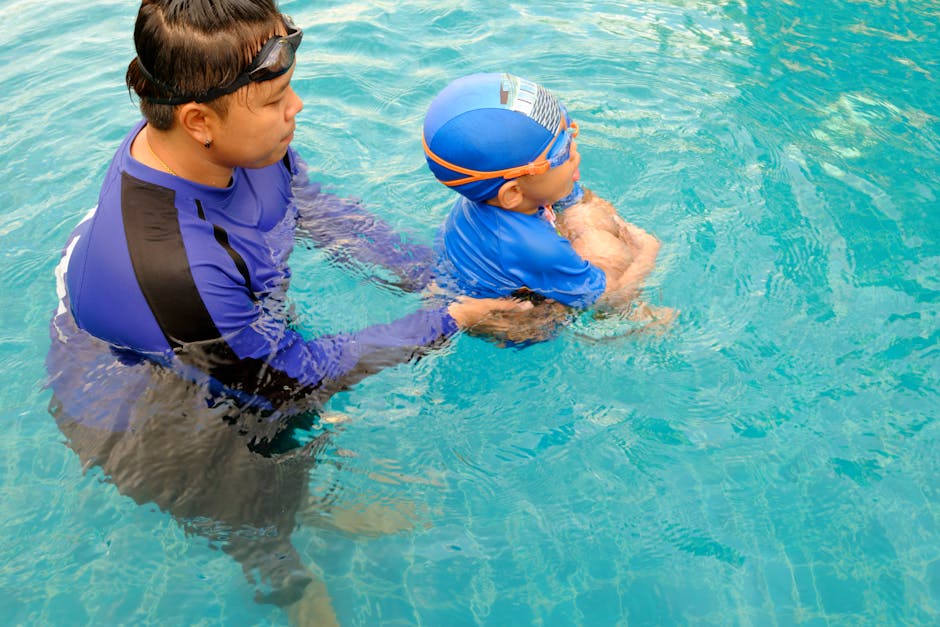
When evaluating potential schools, pay close attention to:
- Instructor Qualifications: Instructors must be certified in infant-specific swim instruction, CPR, and First Aid. They should demonstrate a patient, gentle teaching style and understand early childhood development.
- Student-to-Teacher Ratios: For parent-child group classes, a ratio of no more than 6:1 or 10:1 (depending on pool size) ensures the instructor can provide personalized feedback to every family.
- Touch Supervision: In any high-quality infant class, safety protocols should dictate that an adult is within arm’s reach of the baby at all times.
- Pool Hygiene and Air Quality: Look for state-of-the-art filtration systems and proper ventilation to ensure the pool environment is clean and easy on sensitive infant lungs.
To help narrow down your local search, you can read our comprehensive resources. We encourage you to Read our guide to finding mom and tot swim classes for a deeper look at what makes a program exceptional.
Safety Protocols and Pool Environment
A baby’s body cannot regulate temperature the way an adult’s does. This makes pool temperature one of the most critical factors of all.
For infants and toddlers under three years old, the American Academy of Pediatrics (AAP) recommends pool water be heated to 87°F to 94°F. At American Swim Academy, we maintain our indoor pools at a cozy 92°F year-round. This ensures your baby remains relaxed, warm, and happy throughout their lesson, rather than shivering or tensing up from chilly water.
Additionally, a reputable swim school must enforce a strict double-diaper policy for all children who are not fully potty trained. This typically requires a disposable swim diaper worn underneath a snug-fitting, reusable neoprene swim diaper (like a Happy Nappy). This simple rule keeps the water clean and safe for everyone.
Finally, the school should teach and practice “Water Watcher” principles, reminding parents that swim lessons are a single layer of protection and never a replacement for focused, undistracted adult supervision.
Accommodating Special Needs and Varying Comfort Levels
Every child progresses at their own pace, and some require extra patience and specialized care. Whether your baby is experiencing intense water anxiety or has physical or cognitive developmental delays, the program you choose should be highly adaptable.
Adaptive aquatics programs are designed to accommodate children with diverse learning needs, including autism, sensory processing sensitivities, and physical challenges. A quality swim school will offer gentle, gradual progression pathways that respect your child’s comfort boundaries.
By utilizing positive reinforcement, sensory-friendly teaching tools, and customized pacing, instructors can help even the most timid infants build self-confidence and learn to love the water.
To explore how we structure our classes to support every unique swimmer, you can Explore our diverse swim programs.
Frequently Asked Questions about Infant Swim Lessons
At what age can babies safely start swim lessons?
Most aquatic experts and swim schools recommend starting formal water adaptation classes between 4 and 6 months of age. At this stage, babies have developed sufficient head and neck control to safely participate in basic water movements, and their immune systems are more mature.
While the AAP notes that formal water survival skills are most effectively mastered starting around age one, parent-child water play classes are highly encouraged for younger infants to build comfort and prevent future water phobias. Always consult your pediatrician before introducing your baby to a public pool.
How long do infant swim lessons typically last and how often should they be scheduled?
Standard parent-tot infant swim lessons typically last 25 to 30 minutes. Because babies tire easily and lose body heat faster than older children, keeping lessons under half an hour ensures they remain focused, warm, and happy.
For best results, consistency is key. Attending lessons once or twice a week year-round helps babies retain their water comfort and build muscle memory. Stopping lessons during the winter months often leads to developmental regression, meaning you may have to spend several weeks rebuilding their comfort level come spring.
What should my baby wear to their first swim class?
Your baby should wear a comfortable swimsuit over a strict double-diaper system if they are not potty trained. This consists of:
- A disposable swim diaper (designed not to swell in the water) or a reusable insert.
- A snug-fitting, reusable neoprene swim diaper worn over the top to prevent leaks.
Avoid using standard everyday diapers, as they will instantly absorb pool water, become incredibly heavy, and burst. Don’t forget to pack a warm towel, a changing mat, and a cozy hat for your baby to wear after exiting the warm pool building!
Conclusion
Choosing the right swimming classes for infants is one of the most proactive steps you can take to protect your child and set them up for a lifetime of aquatic joy. Whether your goal is to build a beautiful bonding routine, encourage physical development, or ensure your child possesses life-saving self-rescue skills, early water exposure is an invaluable gift.
At American Swim Academy, we are dedicated to making those first splashes safe, warm, and filled with smiles. With our year-round indoor pools heated to a perfect 92°F, exceptionally small class sizes, and a team of deeply caring, experienced instructors, we provide the ultimate environment for your baby’s water journey.
We serve families across the Bay Area with convenient locations in Fremont, Newark, Livermore, Dublin, and Walnut Creek, CA.
Ready to take the first step? Get started with our water adaptation program today and watch your little one bloom into a confident, water-safe swimmer.