

Why Swimming Lessons for Infants Could Save Your Child’s Life
Swimming lessons for infants are one of the most important early investments you can make in your child’s safety and development.
Here’s what most parents want to know right away:
- When can babies start? Many programs accept infants as young as 4-6 months old.
- Are they safe? Yes, when taught by qualified instructors in warm, clean water with proper supervision.
- What do babies learn? Water comfort, floating, breath control, and basic safety responses.
- Do parents participate? For babies under roughly 2-3 years, yes – a parent or caregiver gets in the water too.
- Do they actually prevent drowning? Research suggests formal swim instruction can reduce drowning risk in young children by 88%.
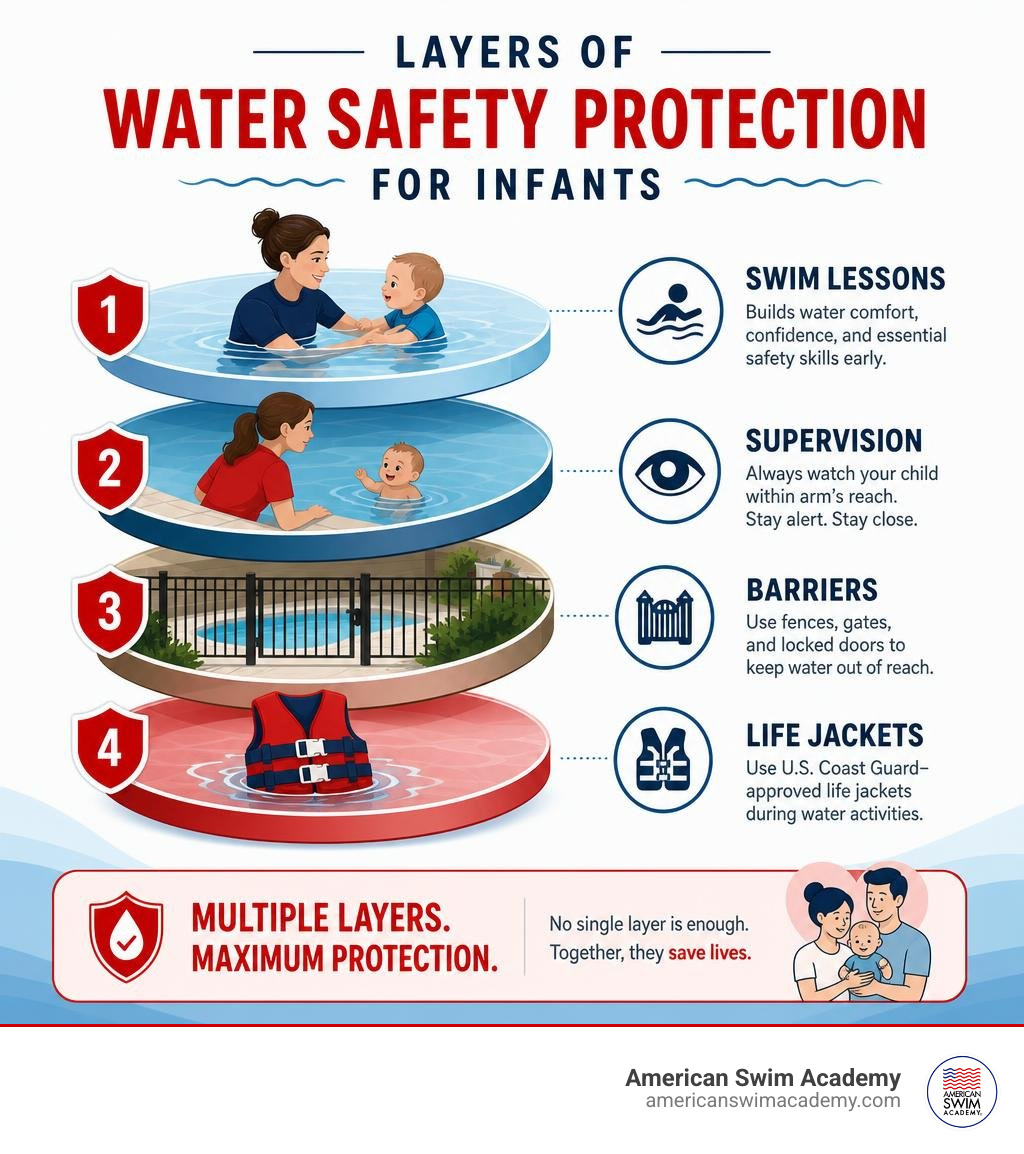
Drowning is the leading cause of accidental death for children aged 1-4. What makes that statistic even harder to read is this: 69% of those children were not expected to be near water at the time. Accidents happen fast – and silently. For authoritative prevention guidance, the Centers for Disease Control and Prevention recommends using multiple layers of protection around water, including close supervision, barriers, and swim skills.
The good news is that early swim lessons are one of the most effective layers of protection you can put in place. They also support physical development, build confidence, and create a meaningful bonding experience between you and your baby.
This guide walks you through everything you need to know – from the right age to start, to what your baby will actually learn in the water.
The Benefits of Early Water Acclimation
Introducing your baby to the pool at an early age does far more than prepare them for future summer pool parties. Early water acclimation lays a physical, cognitive, and emotional foundation that benefits your child for years to come.

Physical and Motor Skill Development
Water provides a unique, low-impact environment where infants can move their bodies in ways that aren’t yet possible on land. The natural resistance of water helps build muscle strength, coordination, and balance.
According to a long-term study conducted in Iceland, infants who participated in just two hours of swimming per week for four months during infancy scored notably higher on tests of motor function, gripping, reaching, and static balance years later compared to their non-swimming peers. The gentle resistance of the water acts as an ideal gym for a baby’s developing muscles, helping them hit physical milestones with greater ease.
Cognitive and Emotional Growth
The sensory-rich environment of a swimming pool stimulates brain development. When babies splash, kick, and feel the water on their skin, millions of new neural connections are created.
Moreover, learning to navigate a new medium builds immense self-esteem. As babies learn that they can control their movements in the water, their confidence grows. This early sense of mastery translates into a resilient attitude toward learning other challenging life skills as they grow. To understand how these early experiences shape your child’s security, you can read more about how swimming lessons keep your child safe.
Deepening the Parent-Child Bond
For parents, infant swim classes offer a rare, distraction-free opportunity to connect with their little ones. With no phones, screens, or household chores to pull your attention away, you are entirely focused on your baby.
Holding your baby close in the water, maintaining constant eye contact, and sharing the joy of their first splashes builds deep trust. This shared vulnerability and success strengthen your emotional connection, proving that baby swim lessons are fun for baby and parents alike.
When to Start Swimming Lessons for Infants
One of the most common questions we hear in the San Francisco Bay Area is: “When is my baby actually ready to start swim lessons?”
While many parents assume they should wait until their child is a toddler, experts suggest beginning much earlier.
The 6-Month Milestone
Most swim schools, including our programs across the Bay Area, recommend starting formal swimming lessons for infants at around 6 months of age. By this point, babies have developed sufficient head and neck control to safely participate in water activities.
Starting at 6 months also capitalizes on a unique developmental window. Infants are born with natural aquatic reflexes, such as automatic breath-holding and swimming movements when submerged. While these reflexes fade as they grow older, introducing babies to the water before these instincts disappear helps them transition naturally to conscious water control. You can learn more about this natural transition through our guide on water adaptation.
The Importance of Warm Water
Babies cannot regulate their body temperature as efficiently as adults. For infants under a year old, pool temperature is absolutely critical. Cold water will quickly cause a baby to tense up, cry, and develop a fear of the pool.
To ensure a positive experience, look for pools heated to between 87°F and 94°F. At American Swim Academy, our indoor pools are maintained at a cozy 92°F year-round, creating a warm, womb-like environment that keeps babies relaxed, happy, and ready to learn. If you are looking for local, warm-water options, check out baby swimming lessons in the Bay Area to find a comfortable facility near you.
For families exploring local options in Northern California, finding a high-quality program designed to introduce babies to the water safely is key. When looking for local classes, prioritize facilities that offer warm water, small class sizes, and experienced instructors who specialize in infant swim development.
Developmental Readiness for Swimming Lessons for Infants
While 6 months is the golden standard for beginning group classes, developmental readiness is ultimately individual. Before enrolling your baby, consider the following physical and emotional milestones:
- Head and Neck Control: Your baby must be able to hold their head up steadily without support.
- Physical Maturity: They should be able to sit up with minimal support, indicating core strength.
- Emotional Comfort: A baby who is extremely sensitive to sensory input may need a slower, gentler introduction to the pool.
- Immune System Health: Ensure your baby is up-to-date on their pediatric recommended vaccines before starting group classes.
If you are wondering how to prepare your child for their first structured group experience, read our helpful resource on water babies: your guide to finding mom and tot swim classes.
Understanding the Risks and Limitations for Babies Under One Year
The American Academy of Pediatrics (AAP) recommends swim lessons as an important layer of protection against drowning starting at age 1. For babies under 1 year old, the AAP notes that while infant swim classes are an excellent way to build water comfort and teach parents safety habits, they do not “drown-proof” a baby.
Parents must keep the following safety protocols in mind when enrolling an infant under 12 months:
- Touch Supervision: An adult must always be within arm’s reach of the infant in the water. Never rely on a baby’s floating abilities as a substitute for active supervision.
- Water Ingestion: Young infants have a natural reflex to swallow water. Instructors must closely monitor babies to prevent them from gulping pool water, which can lead to water intoxication (hyponatremia).
- Temperature Regulation: Limit lesson times to 25–30 minutes for infants under one year to prevent them from getting chilled, even in heated pools.
- Realistic Expectations: At this stage, lessons are about building comfort, breath control, and basic safety reflexes, not mastering strokes.
Understanding these boundaries helps parents set healthy expectations. For more insight on why starting early is still highly beneficial, read about the 3 reasons to get your child in beginner swim lessons.
Key Water Safety Skills and Program Formats
When you enroll your baby in swimming lessons for infants, they won’t be learning the butterfly stroke or the front crawl. Instead, the curriculum focuses on foundational water safety and self-rescue skills.
Core Safety Skills Taught in Infant Swim Lessons
- Breath Control (Blowing Bubbles): Teaching babies to close their mouths and blow bubbles when their face touches the water prevents accidental water inhalation.
- Back Floating: This is the single most critical survival skill. Infants learn to roll onto their backs, arch their hips slightly, and utilize their natural buoyancy to keep their airway clear of the water.
- Roll-to-Breathe / Swim-Float-Swim: Toddlers and older infants learn to swim a short distance, roll onto their back to rest and breathe, and then roll back over to continue swimming to safety.
- Panic Avoidance: By practicing gentle submersions and guided rolls, babies learn to stay calm if their head unexpectedly goes underwater.
- Returning to the Wall: Babies are taught to turn around and grab the pool edge or stairs if they fall into the water.
These basic skills are essential because they build muscle memory that can kick in during an emergency. To read more about how these safety blocks fit together, explore our guide on water safety: the importance of swimming lessons to kids.
What to Look For in Swimming Lessons for Infants
Not all infant swim programs are created equal. When choosing a school for your baby in the Bay Area, make sure they meet these high-quality standards:
- Experienced, Certified Instructors: Instructors should have specialized training in infant swim development, infant CPR, and water safety instruction.
- Warm Water Temperatures: Ensure the pool is heated to at least 88°F–92°F. Cold babies do not learn well.
- High Water Sanitation Standards: Look for facilities that use advanced filtration systems, such as UV-C sanitization, to keep the water ultra-clean for sensitive baby skin.
- Small Class Ratios: For parent-participation classes, a ratio of no more than 6:1 or 4:1 ensures that the instructor can give personalized attention to every family.
- A Positive, Encouraging Environment: Lessons should rely on gentle encouragement, songs, and play-based learning rather than fear or forced submersions.
If you are located in the East Bay, you can find these exact standards at our Fremont swim lessons facility.
Parent-Participation vs. Independent Transition Classes
As you research programs, you will generally find two main formats for infant and toddler swim classes. Here is how they compare:
| Feature | Parent-Participation Classes | Independent Transition Classes |
|---|---|---|
| Typical Age Range | 6 to 36 months | 24 to 36+ months |
| Who is in the water? | Baby, one parent/guardian, and instructor | Child and instructor only (parents watch poolside) |
| Primary Focus | Water comfort, bonding, basic safety, and parental education | Independence, breath control, self-rescue, and basic propulsion |
| Class Ratio | Usually 4:1 to 6:1 (parent-child pairs) | Small ratios, typically 3:1 or 1:1 |
| Teaching Method | Songs, games, gentle guided movements, and shared play | Progressive skill building, structured drills, and independent practice |
Choosing the right format depends on your child’s age, comfort level, and your family’s safety goals. Many parents start with parent-child classes to build a strong foundation before transitioning their toddler to independent lessons. If you’re located near the Tri-Valley area, you can learn more about our local options at our Dublin parent and infant classes location.
Practical Logistics: Gear, Cost, and Scheduling
Before taking your first splash, it helps to be prepared with the right gear and realistic expectations about the commitment required.
- The Double-Diaper Policy: To protect pool sanitation, almost all indoor swim schools require a double-diaper system for children who are not fully potty trained. This consists of a disposable swim diaper (like Huggies Little Swimmers) worn underneath a snug-fitting, reusable neoprene swim diaper (such as a Splash About Happy Nappy). Regular diapers are not allowed as they swell up and dissolve in the water.
- Lesson Duration: Expect classes to be 25 to 30 minutes long. This is the sweet spot for an infant’s physical stamina and attention span.
- Year-Round Consistency: Swimming is a motor skill that requires continuous practice. Taking seasonal summer classes is often not enough, as infants can easily forget what they learned over the winter. Year-round indoor lessons are the safest and most effective way to build permanent water safety habits.
- Cost: Group classes in the Bay Area typically range from $25 to $40 per class, depending on the program format and frequency.
To find a schedule and pricing tier that works for your family, take a look at the structures offered across our programs.
Frequently Asked Questions About Infant Swim Classes
What age can my baby start swimming lessons?
Babies can start water acclimation at home in the bathtub almost immediately, but they are generally ready for formal group classes at 6 months old. At this age, they have developed the necessary neck strength to hold their head up and can safely participate in a structured pool environment.
What should my baby wear to swim class?
Your baby must wear a double-diaper system: a disposable swim diaper underneath a tight-fitting reusable neoprene swim diaper. On top, they can wear a standard swimsuit or a baby wetsuit to help keep them warm if they are particularly sensitive to the water.
Will my baby cry during their first swim lessons?
It is completely normal for babies to cry during their first few classes! The pool is a brand-new sensory environment with different sounds, temperatures, and splashes. Our instructors are trained to use gentle transitions, songs, and reassurance to help babies settle. Most infants adapt and start smiling within a few consistent sessions.
Conclusion
Enrolling your baby in swimming lessons for infants is a beautiful, life-saving step that protects their future while supporting their early development. By starting early in a warm, comfortable, and expert-led environment, you give your child a gift that will keep them safe and confident for a lifetime.
At American Swim Academy, we are proud to offer year-round, indoor infant swim lessons taught by caring, experienced instructors. Our custom-designed pools are kept at a tropical 92°F to ensure your baby’s absolute comfort. With convenient locations across the Bay Area — including Fremont, Newark, Livermore, Dublin, and Walnut Creek — finding a safe, fun, and warm environment for your baby’s first splash has never been easier.
Ready to start your swim journey? Register for Water Adaptation Classes today and take the first step toward building lifelong water safety and confidence!