

Teaching Swimming Lessons Starts With Safety and Simple Skill Progressions
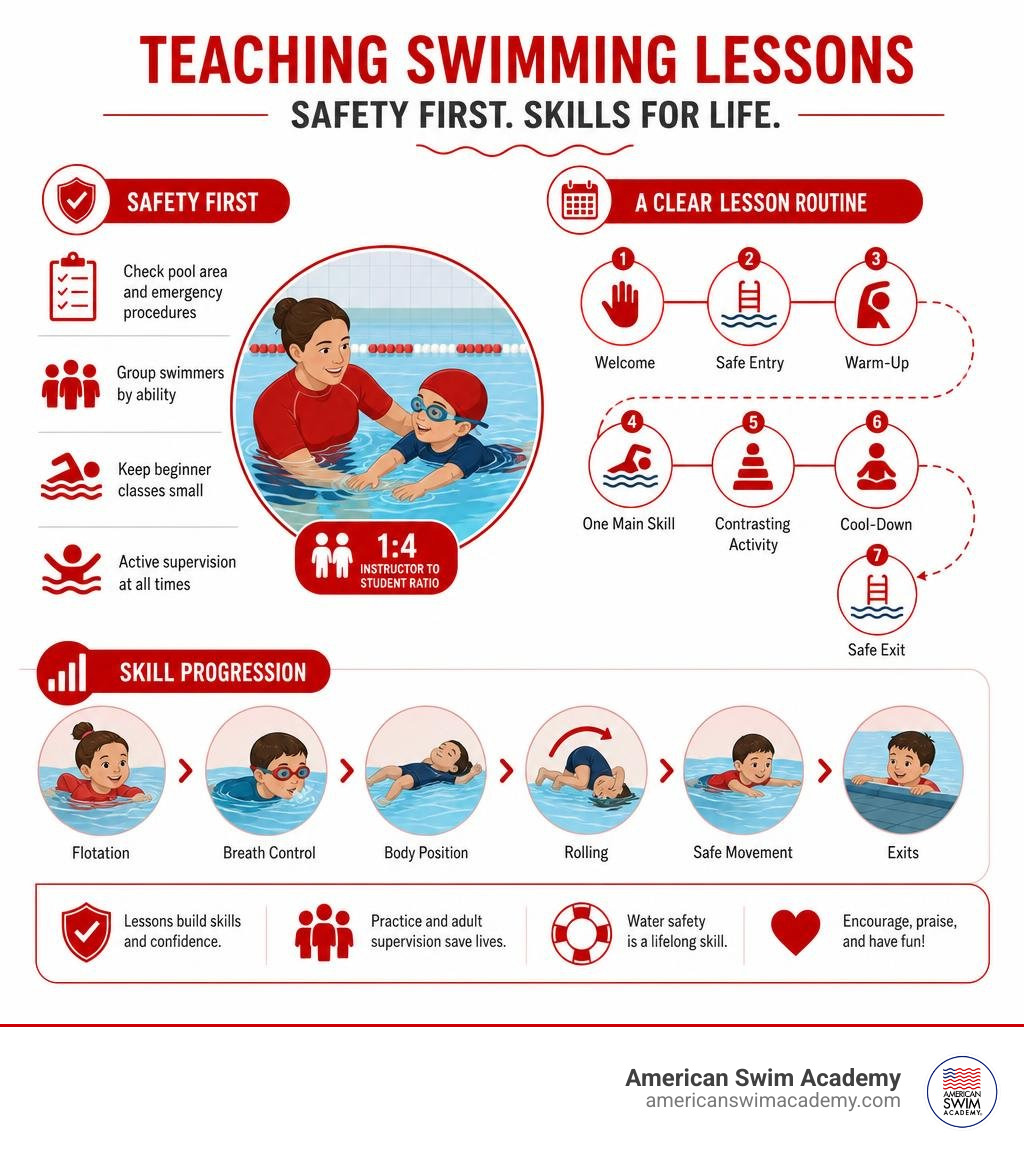
Teaching swimming lessons well means putting safety, trust, and basic water skills before stroke technique. Start by checking the pool area and emergency procedures, group swimmers by ability, keep beginner classes small, and use a clear routine: welcome, safe entry, warm-up, one main skill, a simple contrasting activity, cool-down, and safe exit.
For young beginners learning without a parent in the water, a 1:4 instructor-to-student ratio is a strong best-practice target. Teach flotation, breath control, body position, rolling, safe movement, and exits before asking swimmers to master front crawl, backstroke, breaststroke, or butterfly. Use calm repetition, praise, and adaptations for each learner’s age, confidence, sensory needs, and physical abilities.
Formal lessons can make children safer around water, but no lesson makes anyone completely water-safe. Consistent practice, close adult supervision, and water-safety education all matter.
At American Swim Academy, our team helps families build these skills through warm-water, small-group instruction designed around each swimmer’s progress.
Teaching swimming lessons terms to remember:
Essential Foundations for Teaching Swimming Lessons
Creating an engaging and safe environment is the cornerstone of aquatic instruction. As instructors, we hold a profound duty of care for every swimmer who steps onto the pool deck. This responsibility begins with child protection policies, rigorous facility checks, and maintaining a comfortable physical environment.
Water temperature plays an enormous role in learning efficiency and emotional comfort. When pool water is too cold, children tense up, shiver, and lose focus rapidly. That is why teaching in warm water—ideally maintained at 92°F—keeps muscles relaxed, eases sensory transitions, and ensures swimmers stay focused on instruction. Understanding how swimming lessons keep your child safe starts with acknowledging how environmental warmth and positive reinforcement foster a secure learning atmosphere.
Qualifications and Professional Standards
Professional aquatic educators must possess a strong blend of theoretical knowledge and practical teaching hours. Recognized credentials establish the benchmark for instructional excellence, encompassing physical competence, classroom management, and child development.
Essential standards include:
- National or international swim teaching certifications, such as a comprehensive Level 2 Teaching Swimming qualification.
- Up-to-date CPR/AED and First Aid certifications tailored to infants, children, and adults.
- Comprehensive background checks and child abuse prevention training.
- Continuous guided learning hours covering biomechanics, physical literacy, and inclusive instruction.
Safety Protocols and Student Ratios
Safe instruction requires strict adherence to Normal Operating Procedures (NOP) and facility Emergency Action Plans (EAP). Swim teachers must perform dynamic risk assessments before and during every class, checking pool clarity, deck traction, and equipment integrity.
In addition, dedicated certified lifeguards should always maintain active pool surveillance, allowing swim teachers to focus entirely on instructional delivery without splitting their attention between teaching and broader pool oversight.
Maintaining small class sizes ensures high time-on-task, frequent corrective feedback, and unmatched safety.
| Age / Ability Group | Typical Student Ratio | Primary Safety Focus |
|---|---|---|
| Infant & Toddler (with Parent) | 1:6 to 1:10 pairs | Parent handling, water comfort, gentle submersions |
| Beginner Preschool (Ages 3–5) | 1:4 (maximum 1:6) | Breath control, independent balance, pool exits |
| School-Age Beginners | 1:4 to 1:6 | Streamlining, horizontal propulsion, rolling over |
| Intermediate / Stroke Development | 1:6 to 1:8 | Technique refinement, endurance, rhythmic breathing |
| Adult Beginners | 1:4 to 1:6 | Overcoming anxiety, buoyancy mastery, body alignment |
How to Structure an Effective Swim Lesson Plan
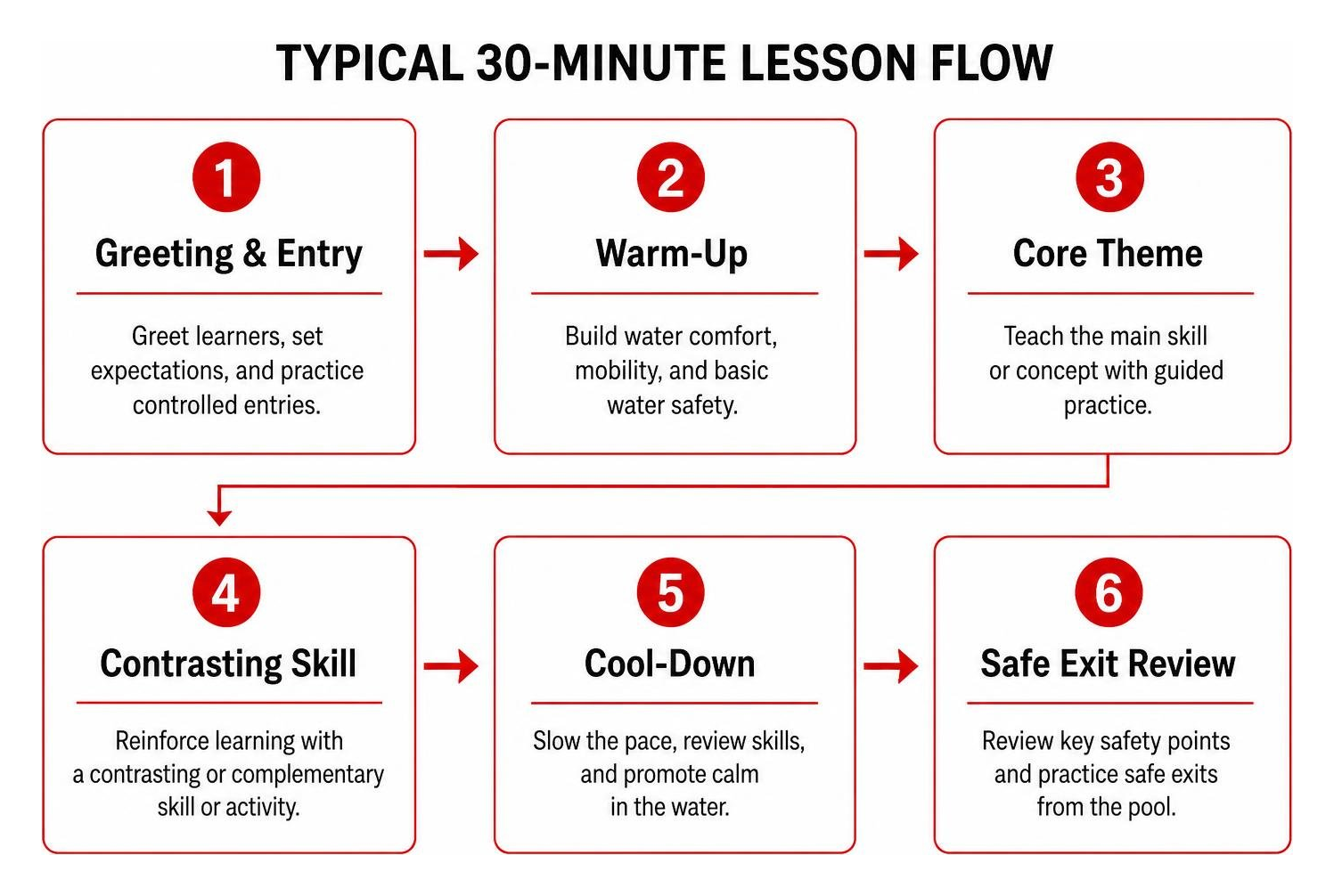
A well-structured lesson plan ensures smooth progressions, minimal downtime, and continuous engagement. For standard 30-minute sessions, pacing should balance active practice with moments of positive reinforcement, ensuring students understand water safety the importance of swimming lessons to kids while building technical skills.
Core Components of a Successful Session
Every productive swimming lesson contains six distinct pedagogical phases:
- Introduction and Safe Entry: Greet learners warmly, set clear behavioral expectations, and practice controlled entries (such as seated slide-ins).
- Warm-Up: Spend 3–5 minutes revisiting familiar foundational movements to elevate heart rates and build immediate comfort.
- Main Theme: Introduce the primary focus of the day (e.g., flutter kick mechanics or side-breathing technique) with progressive micro-steps.
- Contrasting Activity: Introduce an engaging game or complementary aquatic skill (such as sculling or ring retrieval) to reinforce buoyancy without cognitive fatigue.
- Cool-Down: Provide light, low-intensity swimming or floating to relax muscle groups and lower excitement.
- Exit and Wrap-Up: Guide students through safe pool exits, review key milestones, and deliver individualized praise.
Essential safety and instructional equipment includes:
- U.S. Coast Guard-approved flotation devices for specific safety training
- High-density kickboards and pull buoys
- Floating mats, barbells, and aquatic noodles
- Submersible sinking rings and floating interactive toys
- Demonstration tools (e.g., teaching dolls for infant holds)
Fundamental Aquatic Skills and Stroke Mechanics
Before teaching complex competitive strokes, instructors must instill fundamental aquatic literacy. These core principles rely on physical forces like buoyancy, propulsion, and water resistance:
- Breath Control: Teaching rhythmic blowing of bubbles, nose-and-mouth exhalation, and smooth air exchange without swallowing water.
- Streamlining and Body Position: Aligning the head, spine, and hips horizontally at the water’s surface to minimize drag.
- Flotation and Rolling: Mastering relaxed front and back floating, along with the ability to rotate from front to back to breathe independently.
- Propulsion: Developing continuous, narrow flutter kicks originating from the hips rather than the knees, accompanied by effective arm recovery.

When introducing stroke drills, integrating practical tips for learning to swim helps students grasp subtle mechanics like high-elbow catches and relaxed wrist positioning.
Pedagogical Approaches Across Different Learner Stages
Every swimmer approaches the water with unique emotional and developmental needs. Effective swim instructors use differentiated instruction, meeting each student at their current comfort level. Whether breaking down fear barriers or tailoring sensory inputs, our goal is to build genuine confidence step by step through slow easy swim lessons for beginners.
Teaching Swimming Lessons for Babies and Toddlers
Instruction for children under three years old centers on water acclimation, trust, and motor development rather than formal stroke mechanics.
Key priorities for baby and toddler classes:
- Aquatic Holds: Utilize cradles, cheek-to-cheek holds, and hip supports to give infants a sense of security.
- Child-Led Submersion: Never force a child underwater. Always observe non-verbal cues, establish verbal readiness signals (e.g., “Ready, Set, Go!”), and verify relaxed facial expressions before brief submersions.
- Parental Education: Empower parents to serve as confident aquatic partners both in class and at home.
Instructors working with this age group benefit from structured frameworks such as a Level 2 Award in Aquatic Teaching for Baby and Pre-School Swimming, which covers developmental milestones and age-appropriate techniques. Parents looking for these early developmental milestones can explore our specialized our programs pre-school options.
Age-Appropriate Strategies for Teaching Swimming Lessons
As learners advance in age and cognitive ability, instructional strategies shift:
- School-Age Children: Focus on progressive drills, stroke efficiency, spatial awareness, and endurance through structured games and repetition.
- Adult Learners: Adults often carry deep-rooted apprehensions or previous negative experiences. Instructors must explain the physics of buoyancy logically, maintain patient communication, and celebrate small milestones. Discovering beginner swimming lessons for adults why sign up shows how adult-tailored instruction unlocks lifelong aquatic enjoyment.
- Adaptive Aquatics: For neurodivergent learners or swimmers with physical limitations, modify communication using visual schedule cards, reduce sensory overload, and adjust task volume to create an inclusive environment.
Instructor Development, Fault Correction, and Lesson Evaluation
Exceptional swim teachers never stop refining their craft. Successful instruction relies on sharp observation skills, identifying the root cause of a stroke error rather than simply treating the symptom.
When correcting faults:
- Observe Multiple Angles: View the swimmer from poolside, water level, and underneath if necessary.
- Isolate One Correction: Avoid overwhelming the student with multiple critiques. Fix the head and body position first, as alignment usually resolves balance and propulsion issues.
- Use the Sandwich Feedback Technique: Deliver praise, provide a constructive correction, and follow up with positive encouragement.
After every session, take five minutes to reflect:
- Did every learner experience high time-on-task?
- Were safety protocols seamlessly maintained?
- Which drills produced breakthrough moments, and which fell flat?
Creating a continuous personal professional development plan ensures instructional techniques stay sharp, innovative, and deeply effective.
Frequently Asked Questions About Teaching Swimming Lessons
What qualifications are required to become a swim instructor?
Instructors generally need recognized swim teacher certifications, active CPR/AED and First Aid credentials, dynamic water rescue proficiency, and clean background screenings. Continuous professional education in adaptive aquatics and child development is also strongly recommended.
What is the ideal instructor-to-student ratio for beginner swim classes?
For beginner swimmers without parents in the water, industry best practice recommends a ratio of 1:4 (and no more than 1:6). Small classes maximize safety, individualized attention, and active swim time.
How do formal swimming lessons help reduce water risks?
Formal swimming lessons provide structured instruction in breath control, independent flotation, wall recovery, and rolling to breathe. By teaching swimmers how to manage their buoyancy calmly and navigate aquatic environments responsibly, lessons significantly build physical competence and water awareness.
Conclusion
Teaching swimming lessons is one of the most rewarding endeavors in physical education. By blending rigorous safety standards, warm water comfort, small class ratios, and patient teaching progressions, instructors give learners a gift that lasts a lifetime. Whether working with infants, school-age children, or adults, professional instruction transforms apprehension into lifelong joy. Explore our programs to see our expert team in action across our California swim centers in Fremont, Newark, Livermore, Dublin, and Walnut Creek.