

Why Small-Group Swim Lessons Could Be the Most Important Class Your Child Takes
Children swim lessons small group formats are one of the safest and most effective ways to teach kids water skills — and finding the right program quickly matters.
Here’s a fast answer if you’re deciding right now:
- Best for infants (4–36 months): Parent-child classes focused on water comfort and bonding
- Best for toddlers and preschoolers (2–5 years): Small-group classes with a 4:1 student-to-instructor ratio
- Best for school-age kids (5–12 years): Progressive stroke-based groups of 4–6 students
- Best for special needs or anxious swimmers: Private or semi-private lessons with adaptive instruction
- Key stat: Drowning is the #1 cause of death for children ages 1–4 — and it can happen in as little as 2 inches of water
That’s the quick answer. But choosing the right program — the right class size, the right level, the right pool environment — takes a little more thought.
Most parents start searching for small swim classes after a scary moment near water, or simply because they want their child to be safe before summer. Either way, you’re making a smart call. Research consistently shows that formal swim lessons dramatically reduce drowning risk for young children.
At American Swim Academy, small class sizes aren’t just a selling point — they’re the foundation of how kids actually learn to feel safe and confident in the water.
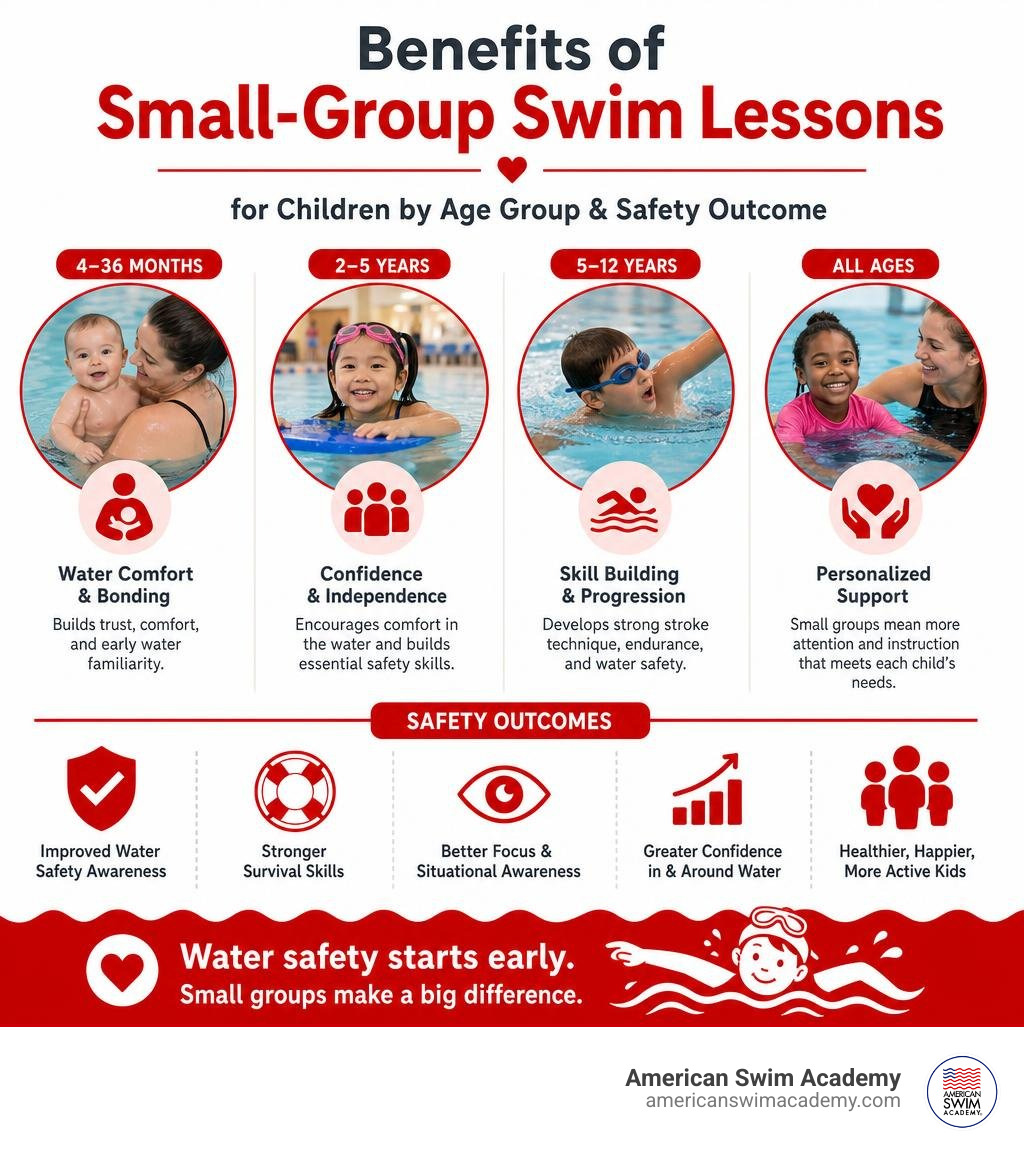
Why Choose Children Swim Lessons Small Group Formats?

When searching for the perfect aquatic program in the East Bay, parents are often faced with a choice: large group lessons at municipal pools, private one-on-one instruction, or small-group classes. While private lessons offer maximum customization, they lack the social element that helps young children thrive. Conversely, large public classes can quickly become chaotic, leaving hesitant swimmers shivering on the steps while waiting for their turn.
Opting for children swim lessons small group settings strikes the perfect balance. Here is why this format is considered the gold standard in swim education:
- The Ideal 4:1 Student-to-Teacher Ratio: With only four children per instructor, every child receives personalized attention. The instructor can immediately correct a hand entry, adjust a body position, or offer a comforting word to an anxious swimmer.
- Peer Learning and Healthy Competition: Children are social creatures. When a hesitant preschooler sees their classmate blow bubbles or put their face in the water, it builds instant social proof. They think, “If they can do it, I can too!”
- Active Engagement and Less Shivering: In a class of ten, a child might spend 80% of their lesson waiting on the pool steps, growing cold and bored. In our small-group format, the rotation is fast and fluid. Kids stay moving, which keeps them warm, engaged, and learning.
- Building Lifelong Trust: A lower ratio allows our certified instructors to build genuine bonds of trust with each child. This emotional safety net is essential for helping kids overcome their fear of the water.
Understanding How Swimming Lessons Keep Your Child Safe goes hand-in-hand with choosing the right class structure. For families exploring options across the Bay Area, checking out resources like Swimming Lessons for East Bay Kids – 510 Families can provide excellent community insights into the regional aquatic landscape.
Structuring Swim Lessons by Age and Skill Level
A great swim curriculum is never “one size fits all.” Children develop physically, cognitively, and emotionally at different rates. To ensure success, lessons must be structured progressively, matching a child’s developmental milestones.
Below is a breakdown of how we structure our class progression to guide children from water acclimation to advanced stroke mechanics:
| Age Group | Class Format | Key Milestones & Goals | Instructor-to-Student Ratio |
|---|---|---|---|
| 4 to 36 Months | Parent-Child (Water Babies) | Water acclimation, gentle submersions, safe entry/exit, parent bonding. | 1:10 (with parents in water) |
| 3 to 4 Years | Preschool Beginners | Breath control, independent front/back floats, flutter kicks, basic separation comfort. | 1:4 |
| 5 to 12 Years | School-Age Beginners | Independent glides, roll-over breathing, introductory freestyle, backstroke. | 1:4 |
| 6 to 12 Years | Intermediate & Stroke Development | Side breathing, breaststroke, butterfly, building endurance and stamina. | 1:5 |
This structured pathway ensures that children are never pushed beyond their emotional readiness, yet are consistently challenged to grow. You can explore the full details of our class structures on Our Programs page.
Water Babies and Toddlers: Laying the Foundation
For our youngest swimmers, the goal is not to teach a perfect freestyle stroke. Instead, it is about building a deep, joyful relationship with the water.
In our parent-child classes, we use songs, sensory play, and gentle guided movements to help infants and toddlers adapt to the aquatic environment. Having a parent in the water provides an immediate sense of security, which prevents the development of water phobias later in life.
During these early sessions, we practice:
- Safe entry and exit: Teaching toddlers to turn around, hold the pool edge, and climb out safely.
- Gentle submersions: Using verbal cues to prepare babies for brief, stress-free submersions.
- Back floats: Helping infants relax on their backs, which is the single most important survival skill.
Starting early is a game-changer. For a deeper dive into how these classes work, read Water Babies: Your Guide to Finding Mom and Tot Swim Classes and discover why Baby Swim Lessons Are Fun for Baby and Parents.
Preschool and School-Age Children Swim Lessons Small Group Progression
As children reach preschool and school age, they are ready to transition to independent learning. At this stage, separation anxiety can occasionally pop up, which is why a small, predictable class environment is so beneficial.
Our beginner curriculum focuses on core water competency skills:
- Breath Control: Learning to blow bubbles, submerge voluntarily, and hold their breath without panic.
- Horizontal Body Positioning: Transitioning from a vertical “dog paddle” position to a streamlined horizontal glide.
- The Roll-Over Breath: Teaching children to swim on their front, roll onto their back to rest and breathe, and then roll back over to continue swimming.
Once these basics are locked in, students progress to formal stroke introduction, learning the mechanics of freestyle (with side breathing), backstroke, breaststroke, and butterfly.
If you are ready to transition your child to independent classes, check out our Beginners page and read about the 3 Reasons to Get Your Child in Beginner Swim Lessons to kickstart their journey.
Essential Water Safety and Survival Skills Taught in Small Classes
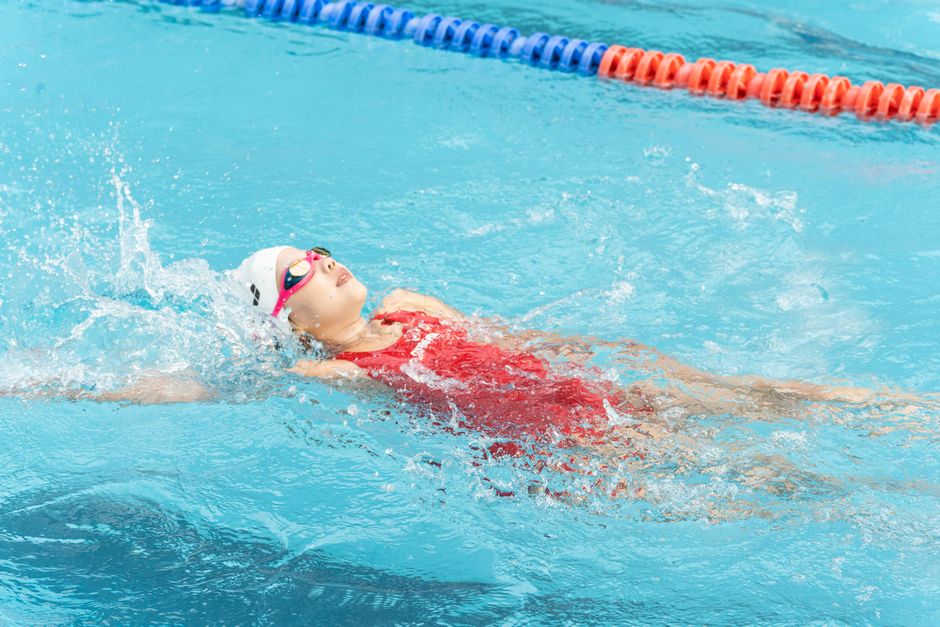
Water safety is the core of everything we do. Drowning is silent, swift, and entirely preventable. While learning beautiful strokes is a wonderful long-term benefit, our immediate priority is giving every child the tools they need to survive an unexpected fall into water.
In a small-group setting, instructors have the eyes and hands-on capability to teach high-stakes safety skills meticulously. We don’t just explain safety; we practice it until it becomes muscle memory.
To understand the broader context of why these safety protocols are so vital, you can read Water Safety: The Importance of Swimming Lessons to Kids. Practicing these safety measures consistently helps build a safer community for families across California.
Mastering the Swim-Float-Swim Technique
The cornerstone of aquatic survival is the swim-float-swim sequence. When a child accidentally falls into a pool, their natural instinct is to swim vertically and splash frantically. This quickly leads to exhaustion and submersion.
We teach children to combat this instinct through a highly structured sequence:
- Swim: The child swims horizontally toward safety (the steps, a wall, or a ladder).
- Float: When tired, they roll onto their back, relax their muscles, and float to breathe and regain energy.
- Swim: Once rested, they roll back onto their stomach and continue swimming toward safety.
By practicing this sequence repeatedly in a small class, children build the muscle memory required to execute it automatically, even under stress. We also teach them how to tread water, swim without goggles (so they don’t panic if their goggles fall off), and safely claw-walk along the pool edge to find an exit.
Teaching these survival skills early offers incredible cognitive and physical benefits. Learn more about how these safety habits take root in our article on the 4 Benefits of Teaching Your Kid How to Swim at an Early Age.
Adaptive Aquatics and Children Swim Lessons Small Group Accommodations
Every child deserves the chance to become safe and confident around water. For children with sensory processing sensitivities, autism spectrum disorders, ADHD, physical limitations, or severe water anxiety, a standard, loud public pool environment can be completely overwhelming.
Small-group formats allow us to create a calmer, highly predictable sensory environment. Our indoor pools are kept at a tropical 92°, which prevents the physical shock of cold water and allows neurodivergent children to focus entirely on their instructor.
Our adaptive approach includes:
- Visual Schedules: Using waterproof picture cards to show students exactly what skills we will practice next.
- Sensory-Friendly Adjustments: Reducing background noise and using gentle, child-led techniques to introduce water submersions.
- Customized Pace: Allowing fearful swimmers to progress at their own speed, building confidence one tiny splash at a time.
We believe that swimming is a universal right. If your child has unique learning needs, read how Swimming Lessons for Kids is a Game Changer to see how adaptive instruction can unlock their potential.
Frequently Asked Questions About Small-Group Swim Lessons
Navigating swim lesson schedules, policies, and placements can feel like a lot to manage. Here are the answers to some of the most common questions Bay Area parents ask us as of June 2026.
How do I know which swim level is right for my child?
Choosing the wrong starting level can lead to frustration if a class is too difficult, or boredom if it is too easy.
To make this process seamless, we recommend using a structured placement approach:
- Age and Experience Check: Start by looking at basic age brackets. Infants and toddlers belong in parent-child classes, while older kids are grouped by basic water comfort.
- The “Voluntary Submersion” Test: Can your child comfortably put their entire head under water and blow bubbles? If not, they are a beginner, regardless of age.
- The Floating Test: Can your child float relaxed on their back for 5–10 seconds without assistance?
- Professional Assessment: The absolute best way to find the perfect fit is to schedule a quick, friendly swim assessment with one of our aquatics directors.
To take the first step and book your child’s quick skill check, head over to our Get Started page.
What are the typical class sizes and instructor-to-student ratios?
At American Swim Academy, we maintain a strict 4:1 student-to-teacher ratio for all of our preschool and school-age beginner classes.
- Why not 1:1? While private lessons are fantastic for rapid skill refinement or highly specific adaptive needs, small groups of four offer peer motivation and observational learning that private lessons lack.
- Why not 6:1 or 8:1? When ratios climb higher, safety margins shrink, and the amount of active “swim time” per child drops dramatically. A 4:1 ratio represents the sweet spot of safety, individualized attention, and social engagement.
What is the policy for cancellations and make-up lessons?
Consistency is the absolute key to building muscle memory in young swimmers. However, we know that kids get sick, school schedules change, and family emergencies happen.
- Our Philosophy on Make-Ups: We believe parents shouldn’t have to choose between keeping a sick child home and losing their hard-earned money. That is why we offer flexible scheduling options and generous make-up lesson opportunities.
- How to Manage Your Schedule: Through our online parent portal, you can easily report an absence in advance and book a convenient make-up slot that fits your schedule.
- Weather and Pool Closures: Because all of our facilities are indoor and temperature-controlled, we swim year-round, rain or shine. In the rare event of an unexpected facility closure, we proactively contact parents to arrange make-ups.
Conclusion
Investing in children swim lessons small group programs is one of the most impactful decisions you can make for your child’s safety, physical health, and personal confidence.
At American Swim Academy, we have spent decades refining a curriculum that makes learning to swim simple, logical, and incredibly fun. By combining highly qualified, caring instructors with a strict 4:1 class ratio and warm, 92° indoor pools, we ensure your child feels comfortable from their very first splash.
Our five Bay Area locations are designed to fit your family’s needs:
- Fremont, CA
- Newark, CA
- Livermore, CA
- Dublin, CA
- Walnut Creek, CA
We swim year-round, making it easy to build consistent safety habits that last a lifetime. Once your child masters the basics, they can seamlessly transition to our advanced stroke clinics to prepare for competitive swim teams or lifelong recreational fitness.
Ready to give your child the gift of water safety? Explore Intermediate and Advanced Programs or sign up for an introductory assessment today. We can’t wait to welcome your family to the pool!