

Start Your Swim Lessons for Adults With Confidence
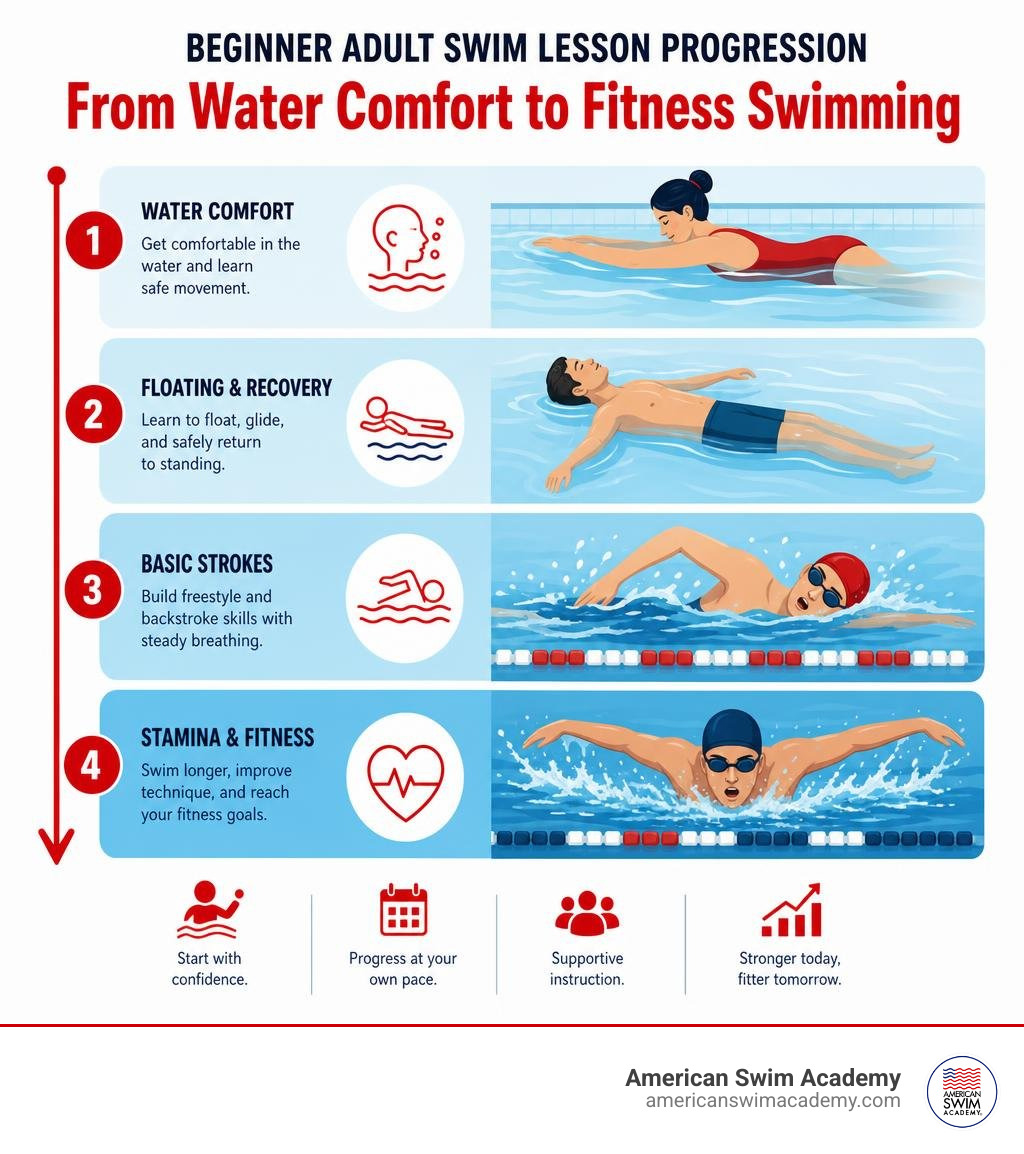
Swim lessons for adults help beginners build water comfort, learn essential safety skills, and develop efficient strokes at a pace that works for them. You do not need prior experience to start. Most programs begin with breathing, floating, and simple movement before progressing to freestyle, backstroke, endurance, and fitness swimming.
A quick beginner roadmap:
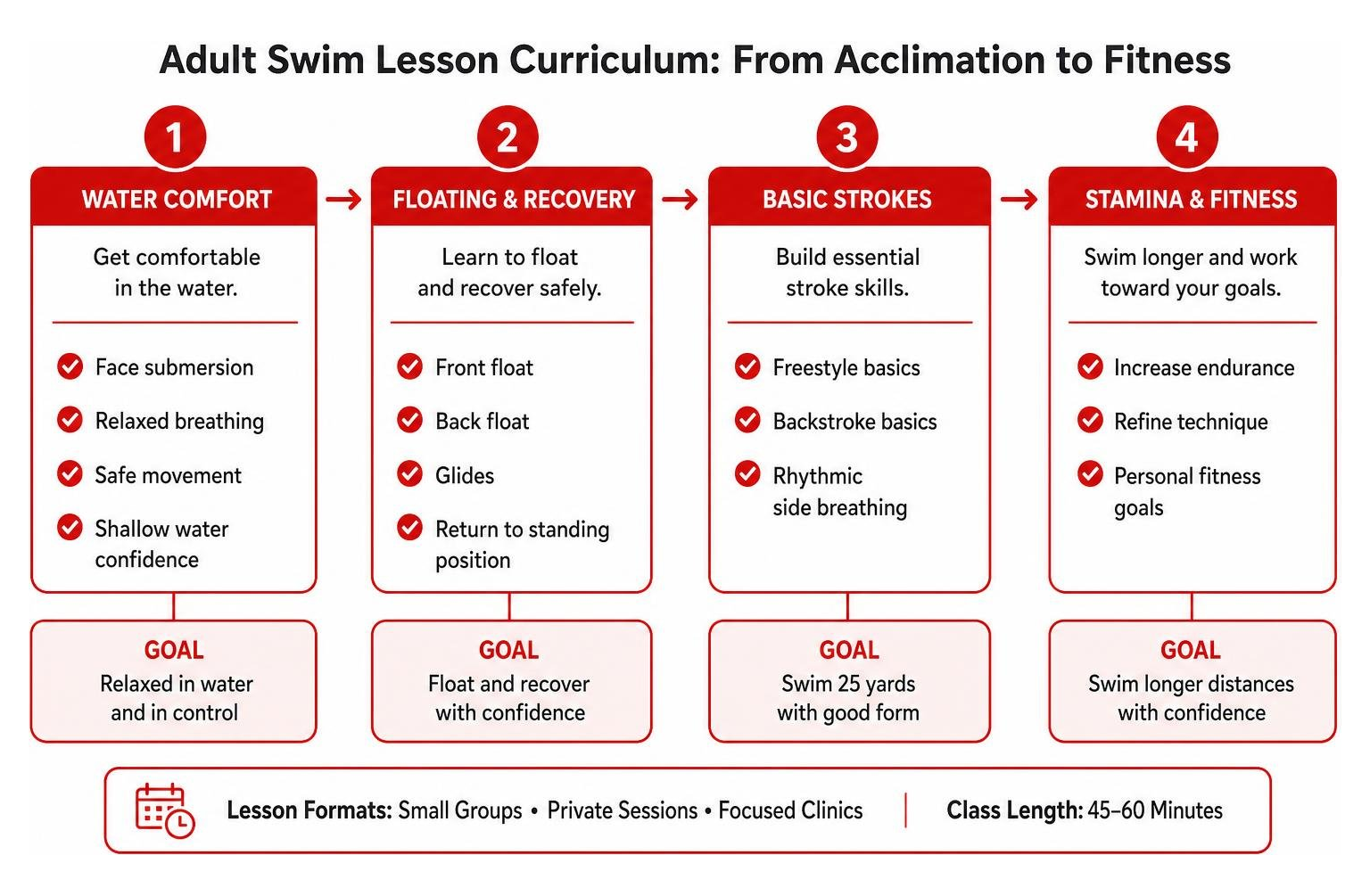
- Water comfort: Practice face submersion, relaxed breathing, and safe movement in shallow water.
- Floating and recovery: Learn front and back floats, glides, and how to return to a comfortable standing position.
- Basic strokes: Build freestyle and backstroke skills, including rhythmic side breathing.
- Stamina and technique: Swim longer distances, refine strokes, and work toward personal fitness goals.
Adult lessons are often offered in small groups, private sessions, or focused clinics. Classes commonly run 45 to 60 minutes, making them a practical option even with a full family and work schedule.
This checklist will help you understand what to expect before your first class and choose a learning path that feels comfortable.
Core Stages and Curriculum of Swim Lessons for Adults
Starting out in the pool as an adult can feel intimidating, but structured programs are designed specifically around how adults learn best. Unlike kids who often learn through free play, adult learners thrive when they understand the physics, biomechanics, and safety reasoning behind every movement.
The pathway from an absolute beginner to an accomplished swimmer is organized into progressive milestones. You master foundational safety habits first before tackling complex techniques. To see the full trajectory of stroke mastery, our From Doggy Paddle To Pro Your Guide To Adult Swimming Coaching breaks down how basic movements evolve into streamlined aquatic power.
Here is an overview of standard adult progression milestones:
| Level | Primary Focus | Key Skills & Drills | Benchmark Goal |
|---|---|---|---|
| Beginner (Foundations) | Acclimation & Safety | Face immersion, bobs, prone & back floats, standing recovery | Relaxed submersion, unassisted 10-second float |
| Intermediate (Stroke Intro) | Form & Breath Control | Flutter kick, rotary breathing, backstroke arms, continuous glides | 25-yard continuous swim with rhythmic side breathing |
| Advanced (Fitness & Endurance) | Stroke Mastery & Stamina | Breaststroke, butterfly basics, turns, pacing drills | 50–100+ yards continuous laps without stopping |
Stage 1: Water Acclimation, Comfort, and Breath Control
The first milestone of any adult program focuses entirely on comfort and relaxation. Many adults who enter the pool hold tension in their shoulders, neck, and chest. In our warm 92° indoor pools across the San Francisco Bay Area—including Fremont, Newark, Livermore, Dublin, and Walnut Creek—warm water plays a huge role in helping muscles unwind so you can breathe naturally.
In this foundational stage, you will focus on:
- Controlled Submersion: Gently putting your mouth, nose, and eyes underwater without panic or nose clips.
- Blowing Bubbles and Bobs: Learning continuous, calm exhalation through your nose and mouth while submerged, and inhaling smoothly when you surface.
- Tension Release: Standing in chest-deep water and finding natural buoyancy through relaxed posture.
- Water Competency Benchmarks: Knowing how to step into the pool safely, move comfortably away from the edge, and return to the wall with ease.
Mastering breath control early stops the instinct to hold your breath, which is the most common reason beginner swimmers tire quickly.
Stage 2: Foundational Floating, Gliding, and Recovery
Once breath control feels manageable, the next step is discovering how your body rests on top of the water. Water supports your weight naturally when your head and spine are aligned.
Key elements practiced during this stage include:
- The Prone (Front) Float: Relaxing face-down with arms extended, feeling your hips and legs rise to the surface.
- The Supine (Back) Float: Leaning back gently with ears in the water and hips lifted to maintain an open airway for easy breathing.
- Standing Recovery: Developing the balance and coordination to bring your knees toward your chest, drop your feet to the pool floor, and stand up securely from any floating position.
- Streamline Glides: Pushing gently from the wall in a streamlined pencil shape, experiencing drag-free movement across the water.
Learning to stand up comfortably from a float gives adult swimmers the confidence to practice in deeper water without worry.
Stage 3: Stroke Introduction and Rotary Breathing
With a strong foundation in floating and balance, you are ready to add propulsion and synchronized breathing. Adult programs introduce freestyle and backstroke first because they share a continuous, long-axis body rotation.
In Stage 3, you will practice:
- Propulsive Flutter Kicks: Generating power from your hips with loose, relaxed ankles rather than bending from your knees.
- Freestyle Arm Mechanics: Developing long, smooth pulls under the body and clean, high-elbow recoveries.
- Bilateral and Rotary Breathing: Rolling your body to the side to inhale smoothly into the natural pocket of air created by your head position, rather than lifting your head straight forward.
- Backstroke Coordination: Combining steady flutter kicking with alternating arm pulls while maintaining a relaxed, horizontal head position.
- Kickboard and Fin Drills: Using training aids to isolate kick strength, streamline position, and side-breathing rhythm across continuous 25-yard laps.
Finding and Selecting the Best Swimming Program

Choosing the right facility and program makes a huge difference in how quickly and comfortably you learn. An optimal adult program pairs experienced instructors with a supportive setting designed for adult comfort and focus. If you are starting your search, our 8 Effective Tips For Finding Swim Classes Near Me highlights the essential criteria to look for in modern aquatic centers.
When reviewing local schools, check for:
- Water Temperature: Cold water triggers muscle tension and shallow breathing. Look for dedicated swim schools with warm pools (90°-92°F) that let you relax from your very first step.
- Class Sizes and Ratios: High student-to-instructor ratios can leave you waiting on the wall. The best group classes cap enrollment at 4 to 6 adults per instructor to ensure personal feedback.
- Instructor Experience: Look for caring, experienced instructors who specialize in adult learners, understand adult biomechanics, and know how to ease water anxiety.
- Year-Round Indoor Facilities: Year-round indoor facilities protect your weekly schedule from cold snaps and seasonal rain.
Choosing the Right Level of Swim Lessons for Adults
Entering a class that matches your current comfort level ensures you make steady progress without feeling overwhelmed or under-challenged. If you are comparing class tracks, reading How To Choose The Perfect Adult Swim Program Without Sinking will help you evaluate your current abilities accurately.
Use this simple self-assessment guide:
- Beginner Track: Select this if you feel nervous putting your face underwater, cannot float unassisted on your front or back, or have never taken formal swim lessons.
- Intermediate Track: Choose this if you are comfortable in shallow and deep water, can float and glide on your own, and can swim 10 to 15 yards of basic freestyle or backstroke, but need work on side breathing and endurance.
- Advanced / Fitness Track: Join this level if you can swim 25 to 50 yards of continuous freestyle with rotary breathing and want to refine stroke mechanics, learn breaststroke or butterfly, and build workout conditioning.
Budgeting and Scheduling Your Swim Lessons for Adults
Adult group swim classes typically cost between $100 and $150 per month for once-weekly sessions, while private one-on-one coaching generally ranges from $50 to $75 per single 45-to-60-minute session. Multi-session packages and monthly recurring billing often provide savings.
When reviewing policies, keep these scheduling details in mind:
- Session Length: Most adult classes run 45 to 60 minutes, which strikes a great balance between skill drills, guided practice, and physical recovery.
- Cancellation Windows: Look for facilities with fair, transparent withdrawal policies that require simple advance notice (such as 30 days) if your work or travel schedule changes.
- Make-Up Policies: Life happens! Check whether the swim school provides monthly make-up options so a missed class due to illness or work travel does not set your progress back.
Group Classes vs. Private Instruction and Skill Clinics
Every adult learns differently, and programs offer several training formats to fit different preferences and goals. Finding the right format depends on your budget, learning style, and specific goals, which we explore in detail in From Toddlers To Adults Finding The Perfect Swim Classes.
- Small Group Lessons: Group classes (typically 4-6 students) offer great value, built-in camaraderie, and the encouragement of learning alongside other adults on the same journey.
- Private Coaching: One-on-one sessions give you the instructor’s undivided attention. They are ideal for working through water anxiety or troubleshooting a specific stroke issue.
- Duet Lessons: Semi-private lessons let two friends, partners, or family members train together at a lower cost than individual private lessons.
- Targeted Workshops & Clinics: These 60-to-90-minute single-session workshops focus on specific skills like mastering side breathing, learning open turns, or conquering shallow-water fears.
The Beginner Adult Swimmer’s Checklist: Gear and Pool Etiquette

Arriving prepared helps you feel confident and relaxed from the moment you step onto the pool deck. Here is your essential checklist for your first day:
1. Essential Gear Checklist
- Comfortable, Supportive Swimwear: Choose athletic swimsuits, jammers, or rash guards that stay in place and let you move freely.
- Comfortable Anti-Fog Goggles: Clear, well-fitting goggles keep chlorinated water out of your eyes, letting you see clearly and stay relaxed underwater.
- Silicone Swim Cap: A soft silicone cap keeps hair out of your eyes and mouth while reducing drag.
- Towel and Warm Layer: Bring a plush towel and an easy-to-slip-on hoodie or robe for a comfortable walk to the locker room.
- Reusable Water Bottle: Swimming is a full-body workout—stay hydrated before and after class!
2. Deck and Pool Etiquette
- Rinse Off Before Entering: A quick warm shower before getting in the water washes away lotions, hair products, and skin oils, keeping pool water clean for everyone.
- Arrive 10 Minutes Early: Give yourself plenty of time to change, use the restroom, and meet your instructor on the deck without feeling rushed.
- Communicate With Your Instructor: Always let your instructor know how you are feeling, what your goals are, and if you ever feel uncomfortable during a drill.
- Track Your Progress: Celebrate your milestones, whether that is putting your face in the water without hesitating or finishing your first full 25-yard lap!
Frequently Asked Questions About Adult Swimming
Is it too late to learn how to swim as an adult?
Not at all. You are never too old to learn how to swim. Swimming is a low-impact, lifelong activity that supports joint health, heart fitness, and everyday water safety. Thousands of adults learn to swim every year in calm, supportive, and judgment-free environments.
What is the minimum age requirement for adult swim programs?
Most adult swim programs welcome swimmers aged 14, 16, or 18 and older, depending on the facility track. Adult classes group students with peers, giving you a mature, focused space away from children’s classes.
How many lessons does it take for an adult to learn swimming?
Learning pace varies from person to person. Many adult beginners achieve basic comfort, breath control, and independent floating within 4 to 8 weekly classes. Mastering full freestyle with rotary breathing and building lap endurance typically takes 3 to 6 months of consistent weekly instruction and practice.
Conclusion
Learning to swim as an adult is one of the most rewarding milestones you can achieve. Whether your goal is playing comfortably with family at the beach, exercising without joint strain, or building a valuable life skill, the journey begins with simple, comfortable steps.
At American Swim Academy, we specialize in helping swimmers of all ages develop real water comfort. Our warm 92° indoor pools across Fremont, Newark, Livermore, Dublin, and Walnut Creek, California, offer the perfect setting to build new skills. With caring, experienced instructors and small class sizes, you will receive the personal attention and guidance you need to thrive.
Ready to begin your journey? Take the first step and enroll in adult swim lessons with our friendly team today!