

Why Finding the Right Swimming Lessons Close to Me Matters for Your Child
If you’re looking for swimming lessons close to me, here’s a quick snapshot of your best local options:
| Program Type | Best For | Typical Setting | Year-Round? |
|---|---|---|---|
| Municipal/Recreation | Budget-conscious families | Outdoor/Indoor public pools | Often seasonal |
| YMCA-style programs | Community-focused families | Indoor pools | Usually yes |
| Private swim schools | Flexible scheduling, small groups | Indoor heated pools | Yes |
| Swim academies | Consistent curriculum, specialized care | Indoor climate-controlled | Yes |
| Adaptive programs | Children with special needs or ASD | Varies by provider | Varies |
Finding the right swim program is about more than just convenience. It’s about safety, comfort, and consistency — especially for young children.
The numbers are striking. Swim lessons can reduce the risk of water-related accidents by up to 88%, yet over half of U.S. adults have never taken a single lesson. For children with autism spectrum disorder (ASD), the risk is even more significant — making early, specialized swim instruction genuinely life-changing.
As a Bay Area parent, you’re juggling a lot. You need a program that’s warm, welcoming, and close to home — one that fits your schedule, accommodates your child’s needs, and actually builds real skills.
This guide compares the 7 best types of swimming lessons available near you, so you can make a confident choice — fast.
How to Choose the Best Swimming Lessons Close to Me

When you begin searching for the ideal aquatic program, it is easy to get overwhelmed by the sheer number of options. However, choosing the right environment is critical to ensuring your child develops a lifelong love for the water rather than a lasting fear. The ideal facility does more than simply provide water access; it creates an ecosystem where learning feels safe, natural, and fun.
Key physical and structural attributes of a facility can make or break the learning experience. For instance, a child who is shivering cannot focus on learning how to float or kick. Similarly, an instructor who is managing too many students at once cannot provide the individualized feedback necessary to correct stroke mechanics. When evaluating local options, you should look for facilities that prioritize student comfort, safety, and structured progression.
To help you navigate this decision-making process, we have put together a comprehensive guide on Where to Find the Best Children Swim School in the Bay Area, which breaks down what to look for in a high-quality program.
Key Factors When Searching for Swimming Lessons Close to Me
When evaluating local pools, there are four primary factors you must consider:
- Pool Temperature: This is perhaps the most overlooked aspect of aquatic education. Standard recreational pools are usually kept between 78 and 82 degrees Fahrenheit, which is far too cold for infants, toddlers, and young children. When water temperatures are low, young bodies lose heat quickly, leading to shivering, blue lips, and muscle tension. A warm-water pool (ideally 90 to 92 degrees) keeps muscles relaxed and minds focused on instruction.
- Student-to-Teacher Ratio: Group sizes dictate how much individual attention your child will receive. In large classes, students spend a significant amount of time waiting at the pool wall for their turn, which leads to boredom and cooling down. Small ratios (such as 3:1 or 4:1) ensure that your child is actively engaged and constantly supervised.
- Year-Round Scheduling: Swimming is a perishable skill. When children only swim during the summer months, they often experience significant skill regression by the following year. Consistent, year-round weekly lessons build muscle memory and reinforce safety habits.
- Instructor Qualifications: Ensure that the instructors are not only certified in CPR and first aid but are also specifically trained in early childhood development and gentle, positive reinforcement techniques.
For a deeper look into choosing the right facility for your family’s routine, check out our guide on Suburban Swim Schools: Your Guide to Finding the Perfect Local Pool.
Comparing Local Swim Program Features and Facilities
To help you weigh your options, we have compiled a comparison of the different types of programs available in the Bay Area:
| Feature | Municipal Programs | Private Swim Schools | Year-Round Academies (Our Model) |
|---|---|---|---|
| Water Temperature | Typically 78°F – 84°F | Typically 86°F – 90°F | Warm 92°F year-round |
| Seasonality | Mostly seasonal (summer) | Year-round | Year-round indoor |
| Class Sizes | Often larger (6–10 students) | Small (4:1) | Extremely small & focused |
| Facility Type | Outdoor or multi-use indoor | Dedicated indoor | Dedicated, climate-controlled |
| Curriculum | General recreation | Specialized | Mastery-based safety & strokes |
1. Municipal and Community Recreation Programs
Municipal programs are run by local city parks and recreation departments. These programs are often highly accessible and budget-friendly, making them a popular choice for families looking for seasonal summer activities.
In the Bay Area, several cities offer excellent public recreation swim programs during the warmer months:
- For families in the Fremont area, the Swim Lessons | City of Fremont, CA Official Website provides seasonal registration for local residents.
- If you are located closer to Newark, you can check scheduling and availability through the City of Newark Recreation Department .
- For residents in the Tri-Valley area, summer sessions are hosted by the Swim Lessons (Summer) – Livermore Area Recreation and Park … .
- Dublin residents often look to The Wave Swim Lessons | Dublin Aquatic Center, CA for outdoor summer instruction.
- In the East Bay, the Swim Lessons and Classes | Walnut Creek Arts + Rec offers seasonal classes for various age groups.
While these municipal programs are fantastic community resources, they are often subject to weather conditions, operate primarily in the summer, and feature larger class sizes in cooler, multi-purpose pools.
2. Private Swim Schools
Private swim schools offer a step up in terms of consistency, comfort, and specialized instruction. Unlike municipal programs that share pool space with lap swimmers and public recreation hours, private schools typically operate in dedicated facilities designed solely for teaching.
These facilities generally feature indoor pools, allowing classes to run year-round regardless of wind, rain, or chilly Bay Area winters. Because their business is entirely focused on swim instruction, they tend to offer highly structured curricula, smaller student-to-teacher ratios, and flexible make-up class policies. This model is ideal for parents who want a more personalized, consistent, and convenient learning schedule for their children.
3. Year-Round Indoor Swim Academies
Year-round indoor swim academies represent the gold standard for long-term skill development and safety. By providing a climate-controlled, indoor environment, these academies eliminate the seasonal gaps that cause children to forget what they learned over the winter.
In a year-round academy, the curriculum is structured around continuous progress. Rather than signing up for a rigid 6-week or 8-week session where children are forced to move at the average pace of the class, students in year-round programs advance to the next level as soon as they master their current skills. This mastery-based approach builds deep confidence and ensures that safety habits become second nature. Furthermore, the instructors in these academies are typically professional educators who receive extensive, ongoing training in child psychology, water safety, and advanced stroke mechanics.
4. Warm-Water Swim Facilities
The temperature of the water is not just a matter of luxury; it is a critical safety and educational factor. When a child enters a cold pool, their immediate physiological response is to tense up, hyperventilate, and shiver. This physical discomfort triggers a psychological response of anxiety and resistance.
Dedicated warm-water facilities, which maintain pool temperatures at a cozy 90 to 92 degrees Fahrenheit, completely transform this dynamic. In warm water:
- Infants and toddlers remain calm and relaxed, allowing for gentle water introduction.
- Muscles stay loose and flexible, which makes it much easier to practice floating, kicking, and rhythmic breathing.
- Children do not experience the energy drain associated with trying to keep their body temperature up, allowing them to remain engaged for the entire duration of the lesson.
- The transition into the pool is tear-free, helping children build positive associations with swimming from day one.
5. Small-Group Swim Programs
When searching for swimming lessons close to me, class size should be one of your top criteria. Large group classes often result in children spending up to 80% of their lesson time shivering on the steps, waiting for their turn to swim with the instructor. This lack of activity leads to boredom, distraction, and rapid cooling.
Small-group programs (maintaining low student-to-teacher ratios) solve this problem by ensuring continuous engagement. In a small class:
- The instructor can tailor their teaching style to each child’s unique personality and learning speed.
- Every student receives frequent, immediate feedback and physical adjustments.
- Peer learning is maximized; children watch their classmates succeed and feel encouraged to try the skills themselves.
- Instructors can maintain constant, close supervision, which greatly enhances safety in the water.
6. Parent-and-Me Specialized Programs
For our youngest swimmers, the journey begins with parent-and-me classes. These programs are designed for infants and toddlers (typically starting as early as 6 months old) and require a parent or guardian to be in the water with the child.
The primary goal of these classes is not to teach complex strokes, but to build water comfort and teach foundational safety habits. Parents learn how to hold and support their babies safely in the water, read their child’s cues, and guide them through basic water exploration. Through gentle songs, games, and structured play, infants learn to love the water, practice holding their breath, and develop the muscle memory needed for back floats. This early acclimation builds a seamless bridge to independent swimming as they grow.
7. American Swim Academy
At American Swim Academy, we have spent decades perfecting the art of swim instruction. Our year-round indoor swim lessons are specifically designed to make learning safe, comfortable, and highly effective for infants, toddlers, and children of all ages.
Our unique program features include:
- 92° Heated Pools: Our indoor pools are custom-heated to a warm 92 degrees, ensuring that your child stays warm, relaxed, and ready to learn.
- Small Class Sizes: We maintain exceptionally low student-to-teacher ratios to guarantee personalized attention and high-quality instruction.
- Caring, Experienced Instructors: Our coaches undergo rigorous training to ensure they provide gentle, positive, and encouraging guidance.
- Convenient Bay Area Locations: With state-of-the-art facilities in Fremont, Newark, Livermore, Dublin, and Walnut Creek, we make finding high-quality lessons close to home incredibly easy.
- To explore local reviews and see how we compare to other options across the region, you can browse the Top 10 Best Swimming Lessons/Schools Near San Francisco Bay … .
Ready to give your child the gift of water confidence? Get Started with us today!
Understanding Swim Lesson Levels and Progression
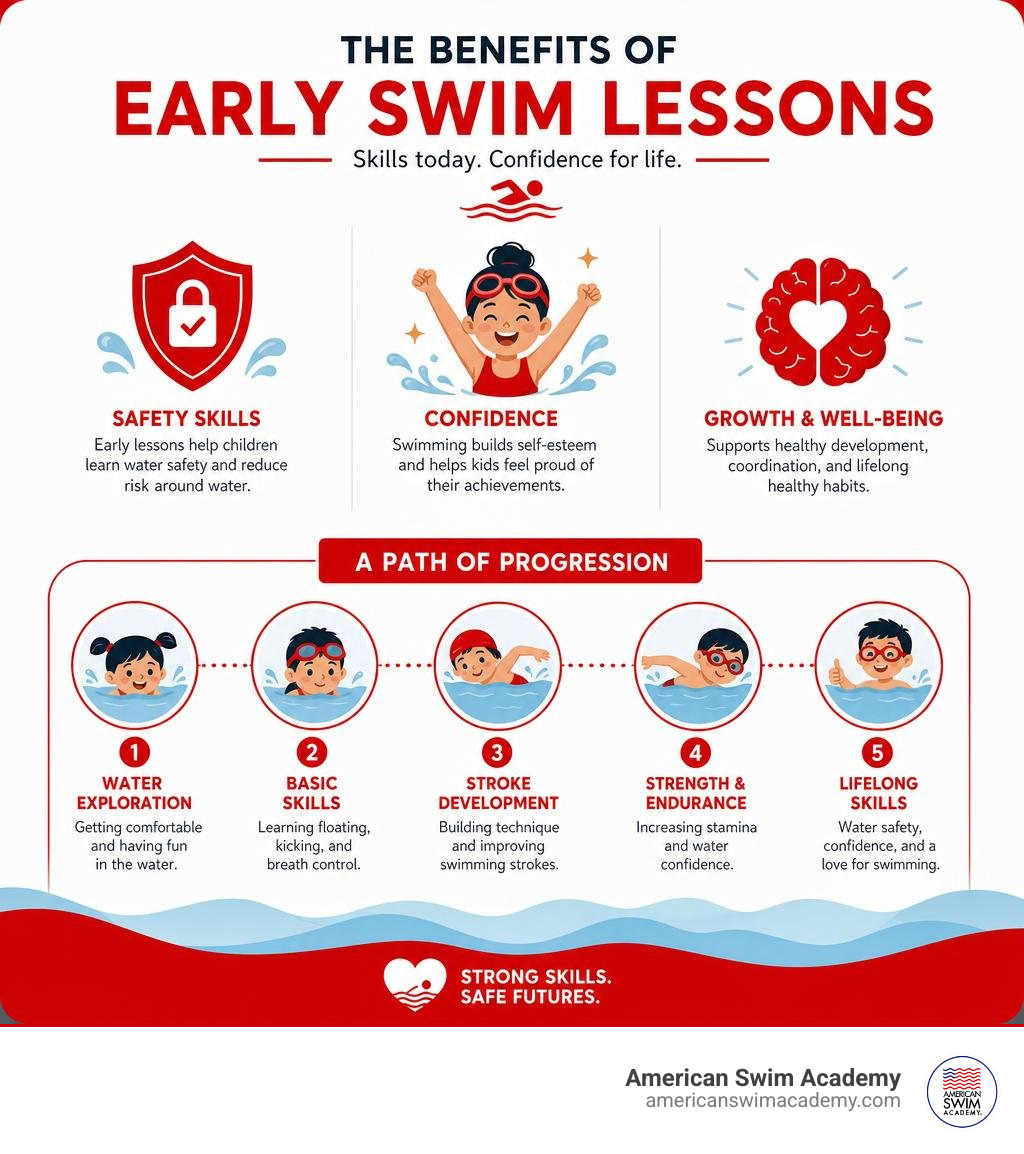
A high-quality swim program does not treat swimming as a single, massive task. Instead, it breaks the learning process down into logical, manageable milestones. This progressive structure ensures that students build a solid foundation of safety and comfort before moving on to complex movements.
Early stages focus entirely on water acclimation—helping children become comfortable with water on their faces, blowing bubbles, and learning how to relax and float on their backs. Once these safety fundamentals are mastered, the curriculum transitions to water movement, independent propulsion, and eventually, advanced stroke mechanics. This step-by-step approach prevents children from feeling overwhelmed and ensures they develop clean, efficient habits from the start.
To learn more about how a structured curriculum helps children move past basic doggy paddling to master true, efficient strokes, read our article on Stop Doggy Paddling: Find the Best Swim Intensive Lessons Near You.
Finding the Right Level for Swimming Lessons Close to Me
Choosing the correct starting point is essential for your child’s confidence. Placing a nervous beginner in an advanced class can cause anxiety, while placing an experienced swimmer in a basic class can lead to boredom.
Most high-quality programs offer a clear progression path:
- Parent-Child (Ages 6 months to 3 years): Gentle water introduction, breath control, and basic safety habits for parents and babies.
- Preschool Aquatics (Ages 3 to 5 years): Building independence, learning to float, kick, and move through the water without parental assistance.
- School-Age Lessons (Ages 5+): Developing rhythmic breathing, building stamina, and introducing formal strokes like freestyle and backstroke.
- Adult Swim Programs: Tailored for teens and adults looking to overcome water anxiety or refine their stroke technique.
If you are wondering how to assess your child’s current abilities and select the perfect class, explore our guide on Swimming Lessons Close to Me.
Adaptive and Private Swim Lesson Options
Every child learns differently, and some benefit from a more tailored approach. For children with physical, cognitive, or sensory challenges, adaptive swim programs provide a highly supportive, low-sensory environment. These lessons focus on water comfort, self-rescue skills, and physical coordination at a pace that respects the student’s individual needs.
Private and semi-private lessons are also excellent options for children who need one-on-one attention to overcome a specific fear, or for advanced swimmers looking to fine-tune competitive strokes. To find out which of our state-of-the-art facilities offer these specialized formats, visit our Locations page.
Frequently Asked Questions About Local Swim Classes
What age should my child start swim lessons?
We recommend introducing children to the water as early as 6 months old. At this stage, infants are naturally adaptable, and early exposure helps prevent the development of water fears later in life. These early lessons focus on water enrichment, gentle movement, and building a foundation of safety.
What should we bring to our first swim class?
For your first lesson, you should bring:
- A comfortable, snug-fitting swimsuit.
- A warm, dry towel.
- A reusable swim diaper (mandatory for all children who are not yet fully potty-trained).
- A change of warm clothes for after the lesson.
How long does it take to learn basic swim skills?
Because every child progresses at their own unique pace, there is no single timeline. Consistency is the most important factor. Children who attend weekly, year-round lessons typically develop strong water independence and basic safety skills within a few months, while stroke refinement and stamina build over years of practice.
Conclusion
Learning to swim is one of the most important gifts you can give your child. It is a life-saving safety skill, a fantastic way to stay healthy, and a gateway to a lifetime of fun water activities. By choosing a high-quality, warm-water program with small class sizes and experienced instructors, you can ensure that your child’s aquatic journey is filled with joy, confidence, and success.
To explore our class schedules and find the perfect fit for your family, visit Our Programs and join our swim family today!