

Why Heated Pool Baby Classes Give Your Baby the Best Start
Heated pool baby classes are warm-water swim lessons designed for infants and toddlers — typically from birth through age four — held in pools kept at around 90–92°F to keep little ones comfortable and focused on learning.
Here’s a quick snapshot of what to look for:
- Age range: Birth through preschool (0–4 years)
- Pool temperature: 90–92°F for infant comfort
- Class size: Small groups for more instructor attention
- Key skills taught: Water adjustment, breath control, floating, kicking, and basic paddling
- What to bring: Swim diaper, towel, change of clothes, and a snack for after
- How to find one: Search for indoor heated pool programs with certified infant swim instructors in your area
Early swimming isn’t just about splashing around. Warm water helps babies feel safe and relaxed, which makes it much easier for them to absorb new movement patterns and build real water confidence — skills that stay with them for life.
Many Bay Area parents tell us the same thing: the moment their baby stopped tensing up in the water and started smiling was a turning point — not just in the pool, but in their child’s overall confidence.
We’re the team at American Swim Academy, and as the Alberti family, we’ve spent years helping Bay Area families find the right fit for their little ones — and we’re here to walk you through everything you need to know.
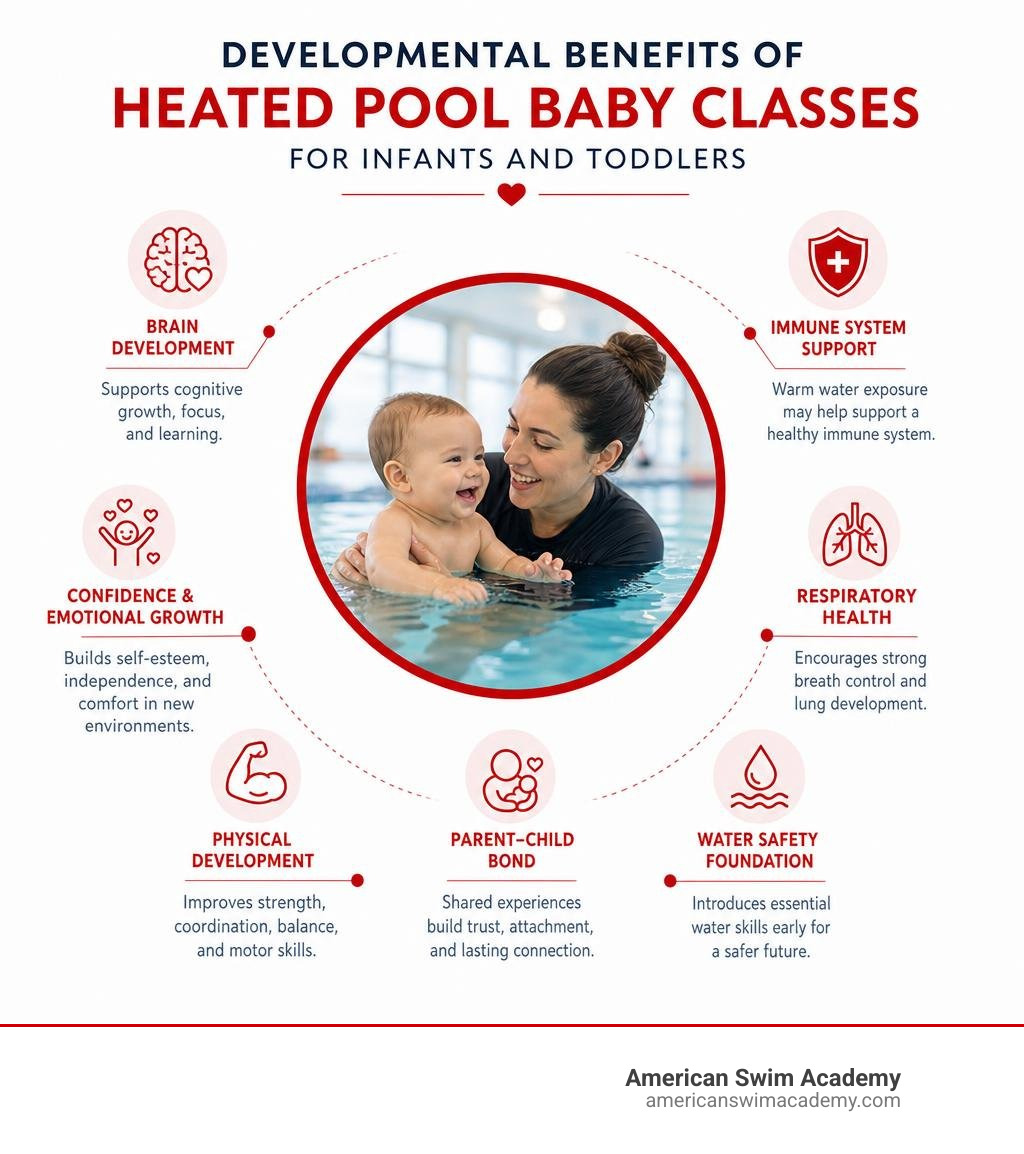
Heated pool baby classes terms to remember:
Why Heated Pool Baby Classes Are Essential for Early Development
When it comes to introducing your infant to the water, environment is everything. Babies have a much harder time regulating their body temperature than adults do. If you place a baby in a standard lap pool—which is usually kept between 78°F and 82°F—they may become uncomfortable more quickly. Cooler water can cause muscles to tense up and make it harder for babies to stay relaxed and engaged.
In contrast, our custom-built indoor pools are kept at a cozy 92°F year-round. This warm-water environment acts like a comforting hug, allowing your baby’s muscles to relax and their nervous system to settle. When a baby feels physically secure, their mind is open to learning, exploring, and bonding.
Physical and Cognitive Benefits of Heated Pool Baby Classes
Swimming from an early age offers incredible benefits that extend far beyond the water. The resistance of warm water provides a gentle, full-body workout that supports your baby’s muscle strength, joint flexibility, and cardiovascular health. According to the American Academy of Pediatrics, early exposure to structured water activities can support both physical and cognitive development in young children.
- Motor Skill Development: Moving in water requires bilateral coordination. Kicking legs and reaching arms simultaneously helps build the neural pathways responsible for crawling, walking, and balance.
- Cognitive Growth: Sensory stimulation is highly active in a warm pool. The feeling of water on their skin, the sound of splashes, and the visual tracking of toys all stimulate rapid brain development.
- Bonding and Trust: These classes offer uninterrupted, skin-to-skin bonding time between parent and child, reinforcing a deep sense of security.
For a closer look at the joy and connection these sessions bring, explore how Baby Swim Lessons Are Fun for Baby and Parents.
Building Water Confidence and Safety Skills Early
Water confidence is a wonderful foundation that lasts a lifetime. By introducing your baby to structured aquatic environments early, you help make the water familiar, turning it into a place of comfort.
Our curriculum focuses on gentle, progressive water adaptation. We teach babies breath control through simple cues, helping them understand when to close their mouths and hold their breath. Gentle, assisted submersions are only introduced when a baby shows clear signs of readiness. This builds a foundation of water comfort, giving parents invaluable peace of mind.
Discover how our introductory levels ease this transition by reading about Our Programs: Water Adaptation.
Key Aquatic Skills Taught in Warm Water Programs
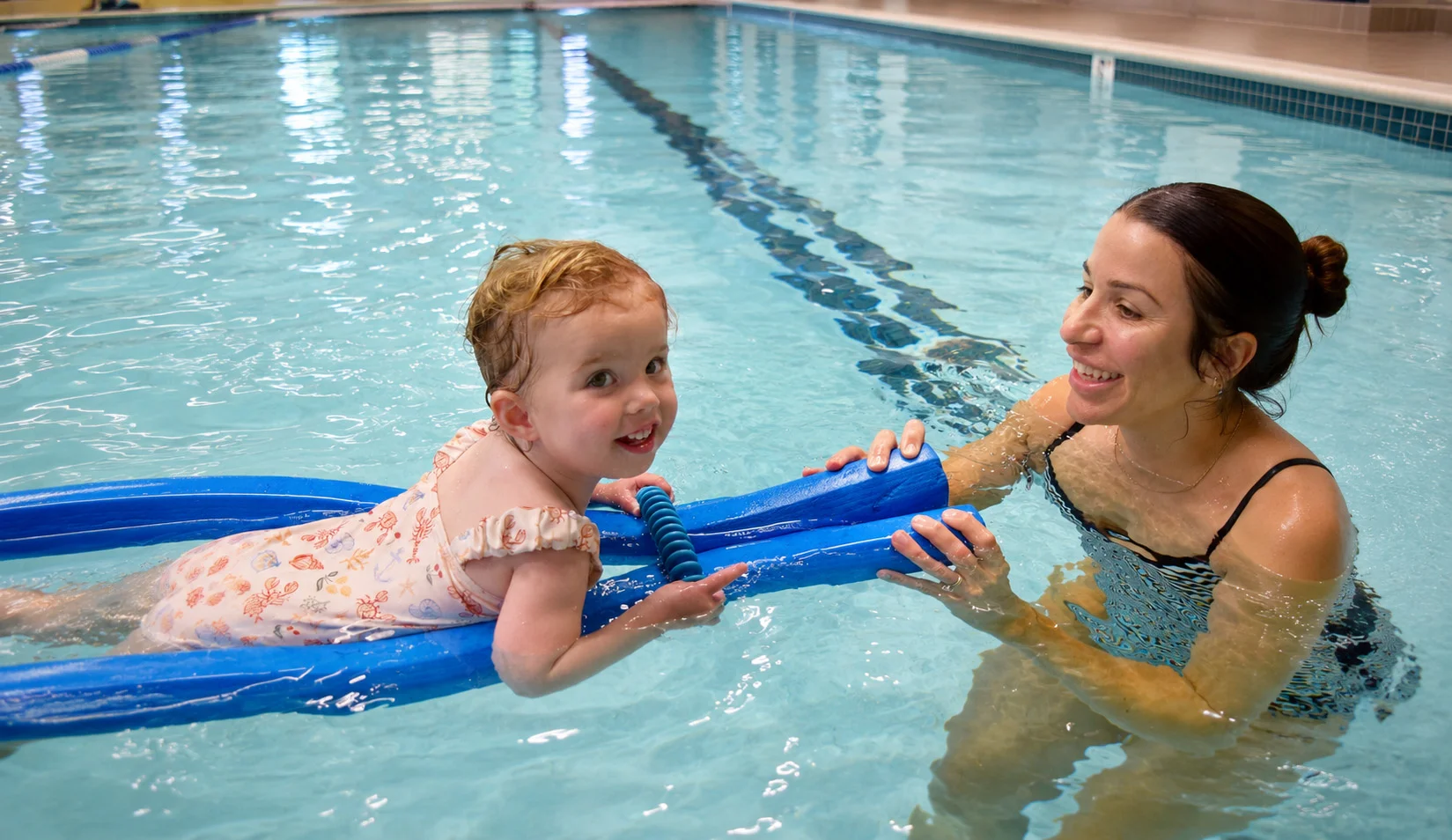
A high-quality infant swim program does not simply let babies float aimlessly. Instead, it uses a research-backed progression of skills disguised as fun, interactive play. Every song sung and game played in our warm pools serves a developmental purpose.
For a complete overview of what to expect in these foundational sessions, check out Water Babies 101: Everything You Need to Know About Infant Swim Lessons.
Age-Appropriate Milestones from Birth to Preschool
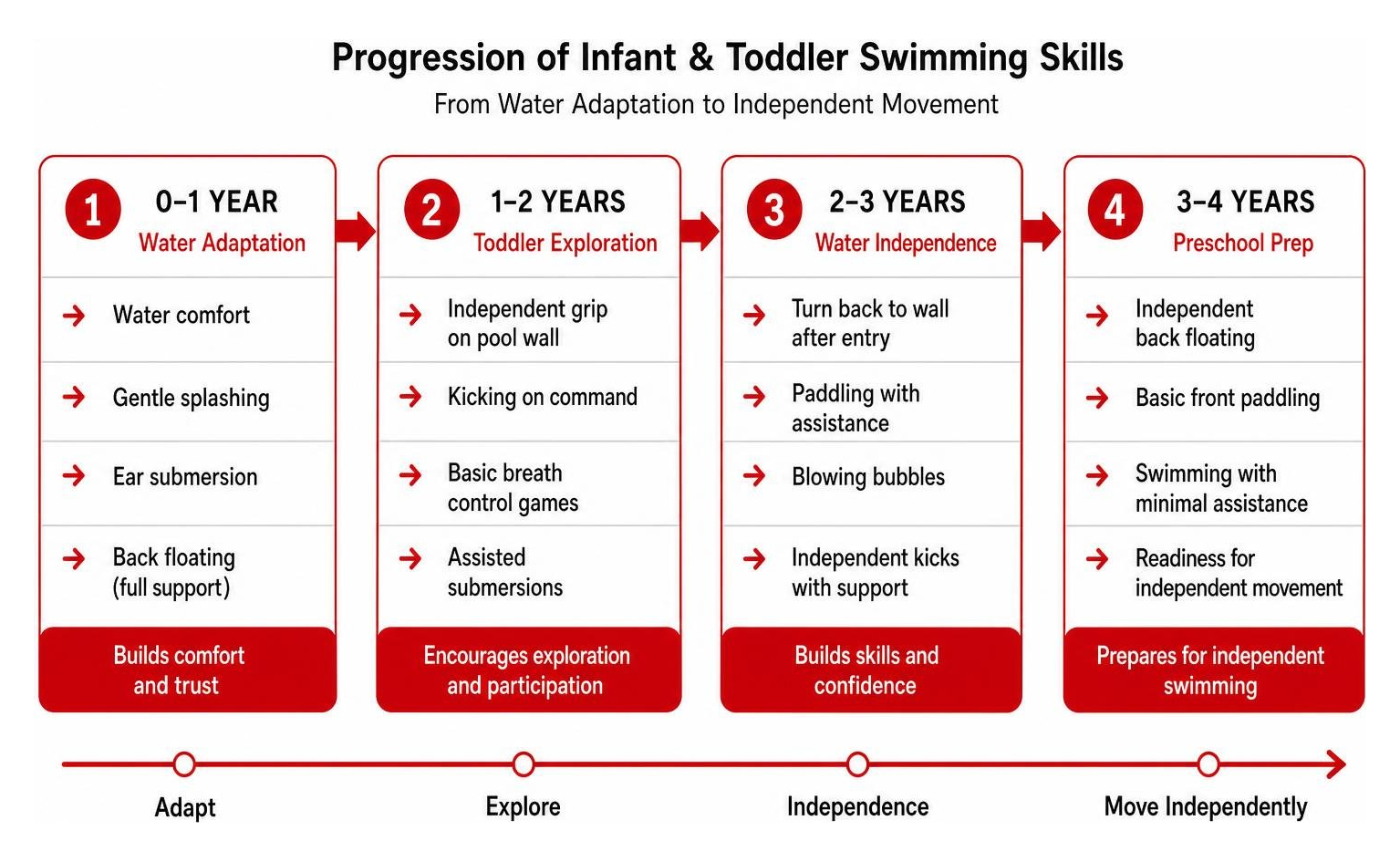
Children develop rapidly in their first few years, and swim programs must adapt to meet their changing physical and cognitive abilities. Here is how we structure our warm water progression to match your child’s developmental stages:
- Age 0–1 (Infant Water Adaptation): Focuses on basic water comfort, gentle splashing, ear submersion, and back floating with full parent support.
- Age 1–2 (Toddler Exploration): Introduces independent gripping of the pool wall, kicking on command, and basic breath control games.
- Age 2–3 (Water Independence): Toddlers practice turning back to the wall after entering the water, paddling with assistance, and blowing bubbles.
- Age 3–4 (Preschool Prep): Focuses on independent floating, basic front paddling, and transitioning to swimming with minimal instructor assistance.
To see how these stages transition into independent swimming, explore Our Programs: Pre-School.
Essential Swimming Strokes and Movement Patterns
While young infants will not be performing perfect freestyle strokes, they learn the foundational movement patterns that make formal strokes easy to master later on.
- Back Floating: This is an essential foundational skill. We teach babies to relax on their backs, keeping their airways clear. Warm water makes this much easier because relaxed muscles float better than tense ones.
- The “Monkey Walk”: Babies learn to hold onto the edge of the pool and shimmy sideways along the wall, teaching them how to navigate to safety.
- Kicking and Paddling: Using songs and colorful toys, we encourage babies to kick their legs and scoop the water with open hands, building the muscle memory needed for forward propulsion.
Learn more about how year-round practice solidifies these habits by reading How to Swim All Winter in a Year-Round Heated Pool.
What to Look For in a Premium Infant Swim Program

Not all swim schools are created equal, especially when it comes to the delicate needs of infants and toddlers. When searching for heated pool baby classes, you should look for facilities specifically designed for young families.
For a detailed checklist on choosing a school in the Bay Area, see Warm Pools Cool Instructors: Your Guide to Fremont Indoor Swim Schools.
Choosing the Right Heated Pool Baby Classes for Your Family
Convenience and comfort are key to maintaining a consistent swim routine. A premium program should offer:
- Warm, Clean Facilities: The pool deck and changing rooms should be clean, warm, and equipped with baby-changing stations.
- Flexible Scheduling: Babies have unpredictable nap and feeding schedules. Look for a school that offers morning, afternoon, and weekend classes to fit your routine.
- Local Locations: Driving long distances with a wet, tired baby is never fun. We offer convenient locations across the Bay Area, including Fremont, Newark, Livermore, Dublin, and Walnut Creek.
If you live in the East Bay, check out our localized advice in Baby’s First Dip: A Guide to Infant Swim Lessons in Walnut Creek, CA.
Qualified Instructors and Research-Based Curriculum
The best facilities employ instructors who are specifically trained in infant development and gentle, child-led teaching methods. Instructors should be patient, encouraging, and highly skilled at reading baby body language to ensure no child is pushed beyond their comfort zone.
To see why pool temperature is such a critical component of a premium curriculum, consider this comparison:
| Feature | Standard Lap Pools | Our 92°F Heated Pools |
|---|---|---|
| Average Temperature | 78°F – 82°F | 90°F – 92°F |
| Baby’s Physical Response | May become distracted by cooler water | Relaxed muscles, easy breathing, comfort |
| Learning Window | May need extra warm-up breaks | Full 30-minute lesson |
| Focus & Engagement | Comfort can vary | Highly engaged, playful, and receptive |
Frequently Asked Questions about Warm Water Swim Lessons
Starting swim lessons is an exciting milestone, but it is completely normal to have questions before your first day in the pool.
For a comprehensive list of answers to common parent questions, visit Our Programs: FAQ.
At what age can my baby start warm water swim lessons?
Babies can begin gentle water adaptation classes very early. Many programs accept infants starting at six months of age, which is when their immune systems are stronger and they have better head control. Starting early helps normalize the aquatic environment before toddler hesitations can develop.
To learn more about the benefits of starting early with a parent-and-child class, read our Mom and Tot Swim Classes Guide.
What should we bring to our first heated pool class?
To ensure a smooth and stress-free first class, we recommend packing the following essentials:
- Double Swim Diapers: Most swim schools require a reusable swim diaper over a disposable swim diaper to help keep the pool clean.
- Snug, Warm Towels: Have a plush towel ready to wrap your baby in immediately after exiting the warm water.
- Change of Clothes: Easy-to-manage, warm clothing for both you and your baby.
- A Post-Swim Snack: Swimming burns a lot of energy! A bottle, breastfeed, or small snack immediately after class will help keep your little one happy on the ride home.
Why is pool temperature so important for babies?
Infants cannot regulate their body temperature as efficiently as older children or adults. In cooler water, a baby’s body heat can dissipate faster than an adult’s.
A pool heated to 92°F helps your baby remain warm, relaxed, and physically comfortable. This optimal temperature keeps their muscles loose and ensures that their first experiences in the water are filled with joy and comfort.
Conclusion
Finding the right heated pool baby classes is one of the best investments you can make in your child’s physical development, safety, and lifelong relationship with the water. By choosing a program that prioritizes warm water, small class sizes, and experienced, caring instructors, you set your little one up for a lifetime of water confidence.
At American Swim Academy, we have spent decades perfecting our infant and toddler swim programs. Our indoor pools are custom-heated to a warm 92°F, creating the perfect year-round environment for your baby to learn, grow, and thrive. With convenient locations in Fremont, Newark, Livermore, Dublin, and Walnut Creek, CA, the perfect warm-water swim class is always just around the corner.
Ready to start your baby’s swim journey? Learn more about our gentle, supportive Water Adaptation Program today and join our swim family!